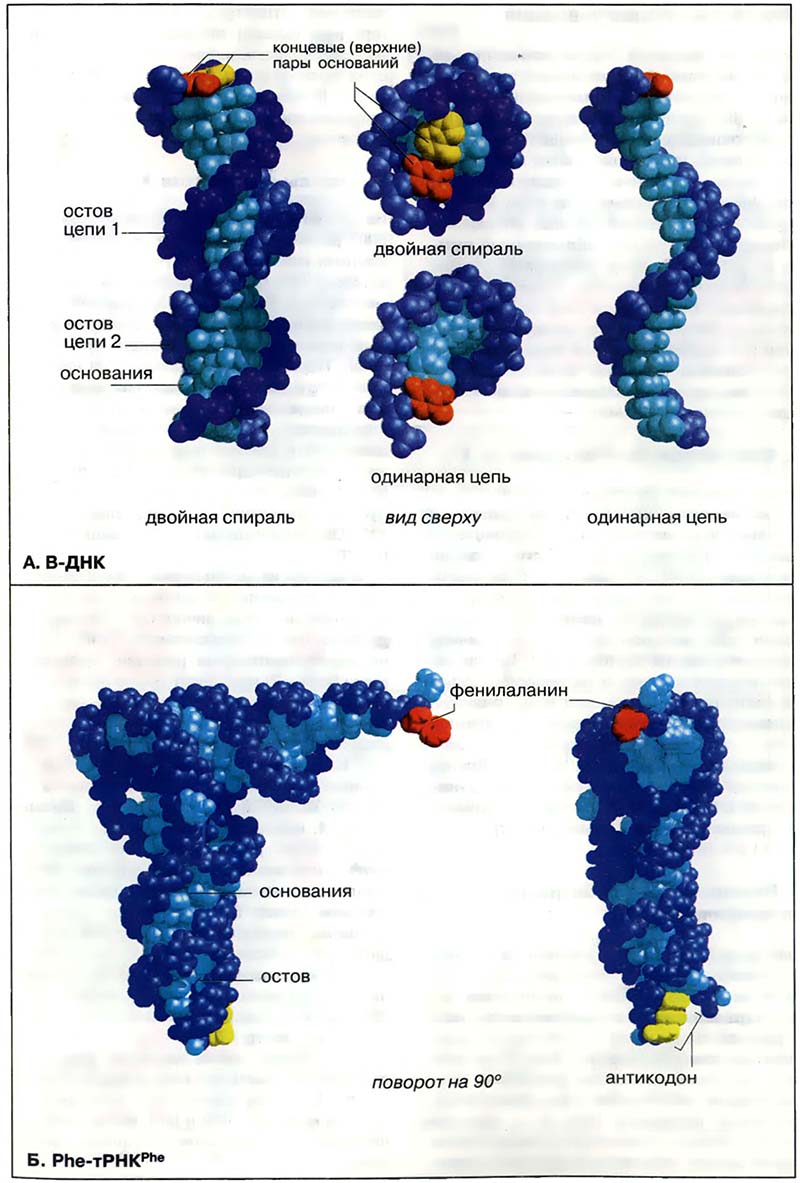
Молекулы РНК не могут образовывать двойную спираль и поэтому не столь высокоупорядочены по сравнению с ДНК. В качестве примера здесь приведена молекула тРНК из дрожжей. Нуклеотидная последовательность этой тРНК и общие принципы строения тРНК обсуждались ранее (см. Рибонуклеиновые кислоты). По аналогии с другими моделями, приведёнными на схеме А, основания окрашены в голубой цвет, остов из остатков рибозы и фосфатных группировок — в тёмно-синий. Связанная на 3′-конце молекула фенилаланина выделена красным цветом (в исследованной тРНК этот аминокислотный остаток отсутствовал).
На модели видно, что тРНК свёрнута в компактную клинообразную структуру. Как и в ДНК, большинство оснований находятся внутри молекулы, в то время как полярный остов — на поверхности. Исключение составляют три основания антикодона (окрашены в жёлтый цвет), который должен взаимодействовать с мРНК. Большинство оснований принимает участие в межмолекулярном спаривании. Некоторые из образованных пар не соответствуют общим принципам спаривания оснований, обычно соблюдаемым в ДНК (A + U, G + C).
На модели видно, что тРНК свёрнута в компактную клинообразную структуру. Как и в ДНК, большинство оснований находятся внутри молекулы, в то время как полярный остов — на поверхности. Исключение составляют три основания антикодона (окрашены в жёлтый цвет), который должен взаимодействовать с мРНК. Большинство оснований принимает участие в межмолекулярном спаривании. Некоторые из образованных пар не соответствуют общим принципам спаривания оснований, обычно соблюдаемым в ДНК (A + U, G + C).
Статьи раздела «Молекулярные модели ДНК и тРНК»:
- Молекулярные модели ДНК и тРНК
- А. В-ДНК
- Б. Phe-тРНКPhe
Структура:
Списки:
Сложность материала:
Величины и единицы:
Книги Список книг
 Histone H1 glycation and rutin metabolites as glycation inhibitors: Nuclear protein glycation in vivo and novel natural product AGE inhibitors
Protein glycation, induced by hyperglycemia, is implicated in the appearance of diabetic complications and the aging process. Glycation involves the ...
 Metals in Medicine
Working from basic chemical principles, Metals in Medicine presents a complete and methodical approach to the topic. Introductory chapters discuss ...
 Isotope Effects: in the Chemical, Geological, and Bio Sciences
As the title suggests, Isotope Effects in the Chemical, Geological and Bio Sciences deals with differences in the properties of isotopically ...
 Biomolecular Crystallography: Principles, Practice, and Application to Structural Biology
Synthesizing over thirty years of advances into a comprehensive textbook, Biomolecular Crystallography describes the fundamentals, practices, and ...