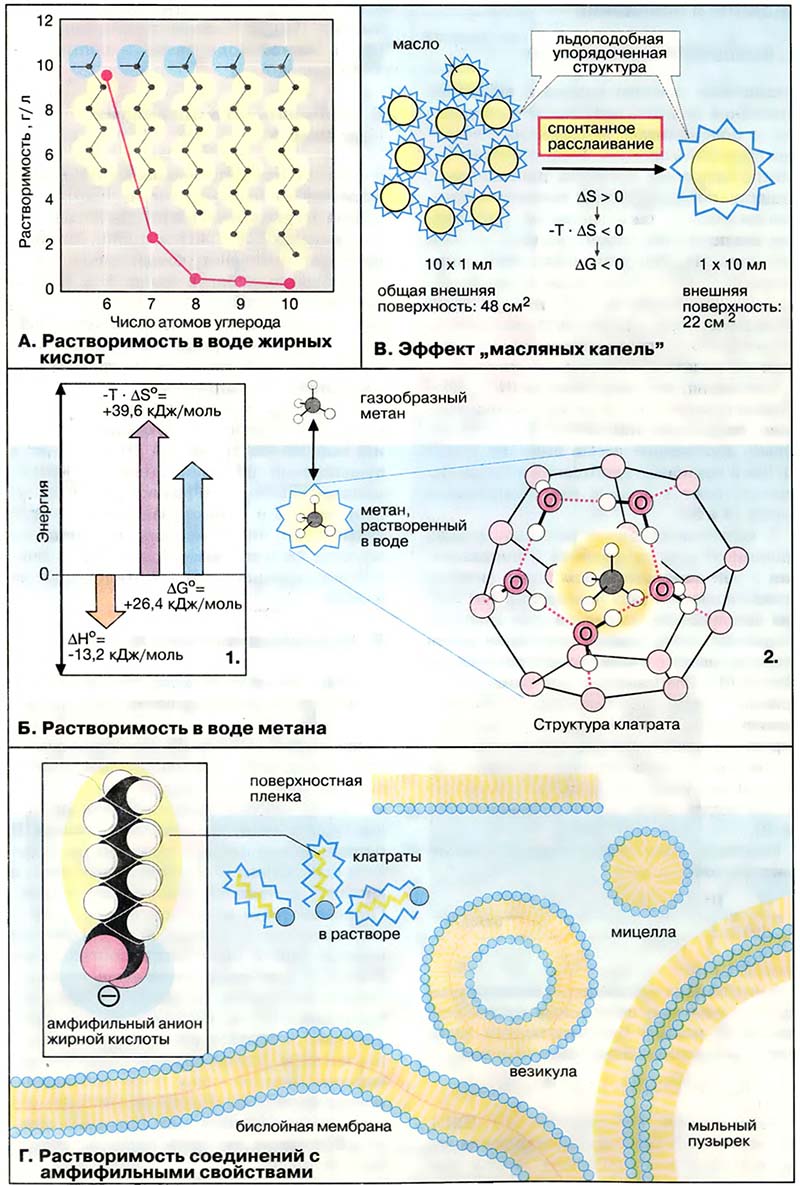
Вещества, имеющие в структуре как полярные, так и неполярные группы, называются амфифильными. К этой группе принадлежат, например, жиры (см. Контроль транскрипции), фосфолипиды и желчные кислоты (см. Фотосинтез: темновые реакции). Вследствие эффекта «масляных капель» (Б) амфифилы при контакте с водой склонны образовывать структуры, у которых площадь контакта неполярной части молекул с водой минимальна. На поверхности воды такие вещества обычно образуют монослойные плёнки, у которых полярные группы ориентированы в воду. Мыльные пузырьки образованы липидными бислоями с тонким наружным слоем воды. В воде амфифилы образуют протяжённые бислойные мембраны или мицеллы, у которых полярные группы ориентированы в воду. По этому принципу построено большинство биологических мембран (см. Биомембраны: структура и функции). Полые мембранные пузырьки носят название везикул. В клетках и крови такие структуры играют ключевую роль при выполнении транспортных функций (см. Транслокация белков. Шапероны, Липопротеины).
Статьи раздела «Гидрофобные взаимодействия»:
- Гидрофобные взаимодействия
- А. Растворимость в воде жирных кислот
- Б. Растворимость в воде метана
- В. Эффект «масляных капель»
- Г. Растворимость соединений с амфифильными свойствами
Структура:
Списки:
Сложность материала:
Величины и единицы:
Книги Список книг
 Fundamentals of Forensic DNA Typing
 An introductory text on forensic DNA analysis, written by the foremost expert in the field.
 История биологической химии. Формирование биохимии
 Книга посвящена истории формирования классической биохимии в период с середины ...
 Physical Properties of Macromolecules
 Explains and analyzes polymer physical chemistry research methods and experimental data Taking a fresh approach to polymer physical chemistry, ...
 Practical Forensic Microscopy: A Laboratory Manual
 Forensic Microscopy: A Laboratory Manual will provide the student with a practical overview and understanding of the various microscopes and ...