Катализ

Катализаторы это вещества, которые влияют на скорость реакции, но сами при этом не расходуются. В живых клетках основными катализаторами являются ферменты (см. Деградация порфиринов). Очень немногие реакции катализируются молекулами РНК («рибозимы», см. Созревание РНК, Рибосомы: элонгация, терминация).
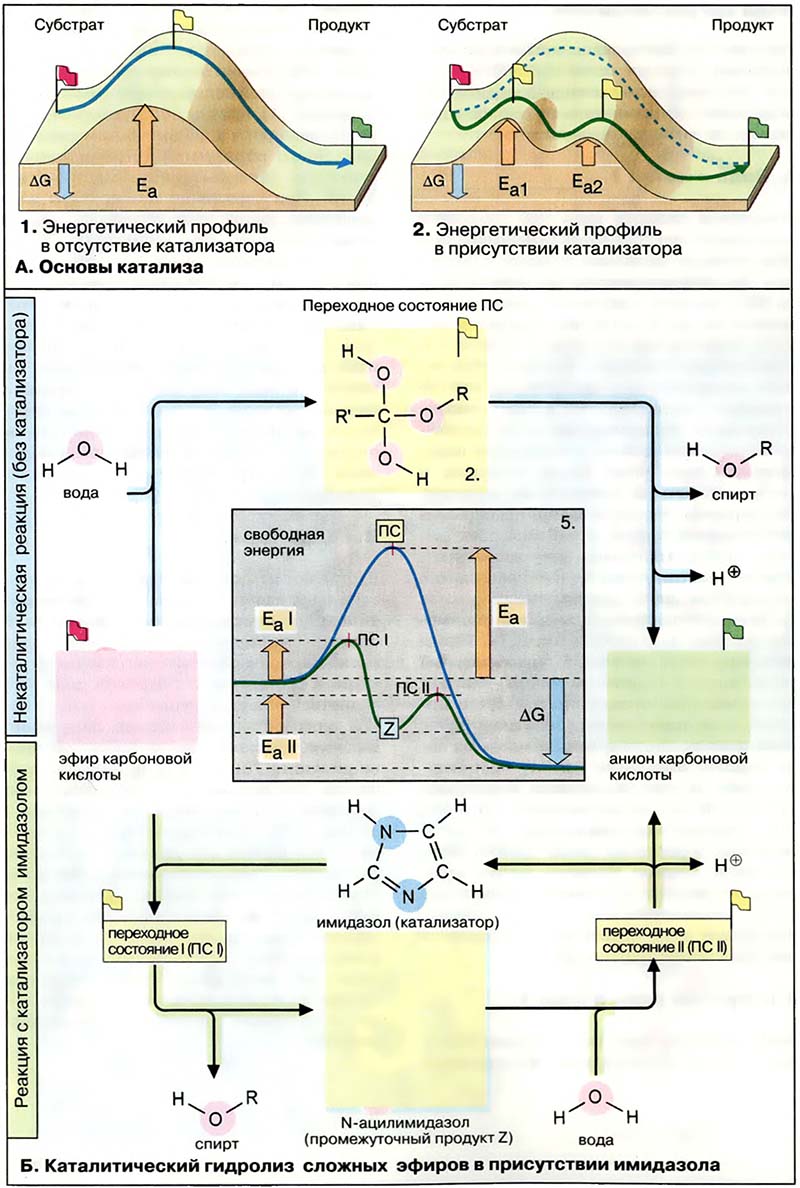

Основы биохимии. Физическая химия / Катализ

Статьи раздела «Катализ»:

Следущая статья   |   — Вернуться в раздел


Основы клинической биохимии / Авторы монографии поставили перед собой задачу отобрать наиболее достоверные и проверенные факты, описанные в литературе и подтверждённые несколькими исследователями. Кроме того, в монографии отражён их личный опыт и собственные исследования, относящиеся к клинической биохимии, выполненные в различнОсновы клинической биохимии
Авторы монографии поставили перед собой задачу отобрать наиболее достоверные и ...
Biomolecular Crystallography: Principles, Practice, and Application to Structural Biology / Synthesizing over thirty years of advances into a comprehensive textbook, Biomolecular Crystallography describes the fundamentals, practices, and applications of protein crystallography. Deftly illustrated in full-color by the author, the text describes mathematical and physical concepts in accessibBiomolecular Crystallography: Principles, Practice, and Application to Structural Biology
Synthesizing over thirty years of advances into a comprehensive textbook, Biomolecular Crystallography describes the fundamentals, practices, and ...
Microarray Image Analysis: An Algorithmic Approach (Chapman & Hall/CRC Computer Science & Data Analysis) / To harness the high-throughput potential of DNA microarray technology, it is crucial that the analysis stages of the process are decoupled from the requirements of operator assistance. Microarray Image Analysis: An Algorithmic Approach presents an automatic system for microarray image processing to Microarray Image Analysis: An Algorithmic Approach (Chapman & Hall/CRC Computer Science & Data Analysis)
To harness the high-throughput potential of DNA microarray technology, it is crucial that the analysis stages of the process are decoupled from the ...
NMR Studies of Structural Motifs: Protein Folding and Ligand Binding / NMR of Structural Motifs: The agrin G3 domain is critical in development and maintenance of the neuromuscular junction. G3 binds -dystroglycan and initiates acetylcholine receptor clustering on myotube membranes. Using NMR spectroscopy, we show both active B8 and inactive B0 isoforms binding sialic NMR Studies of Structural Motifs: Protein Folding and Ligand Binding
NMR of Structural Motifs: The agrin G3 domain is critical in development and maintenance of the neuromuscular junction. G3 binds -dystroglycan and ...