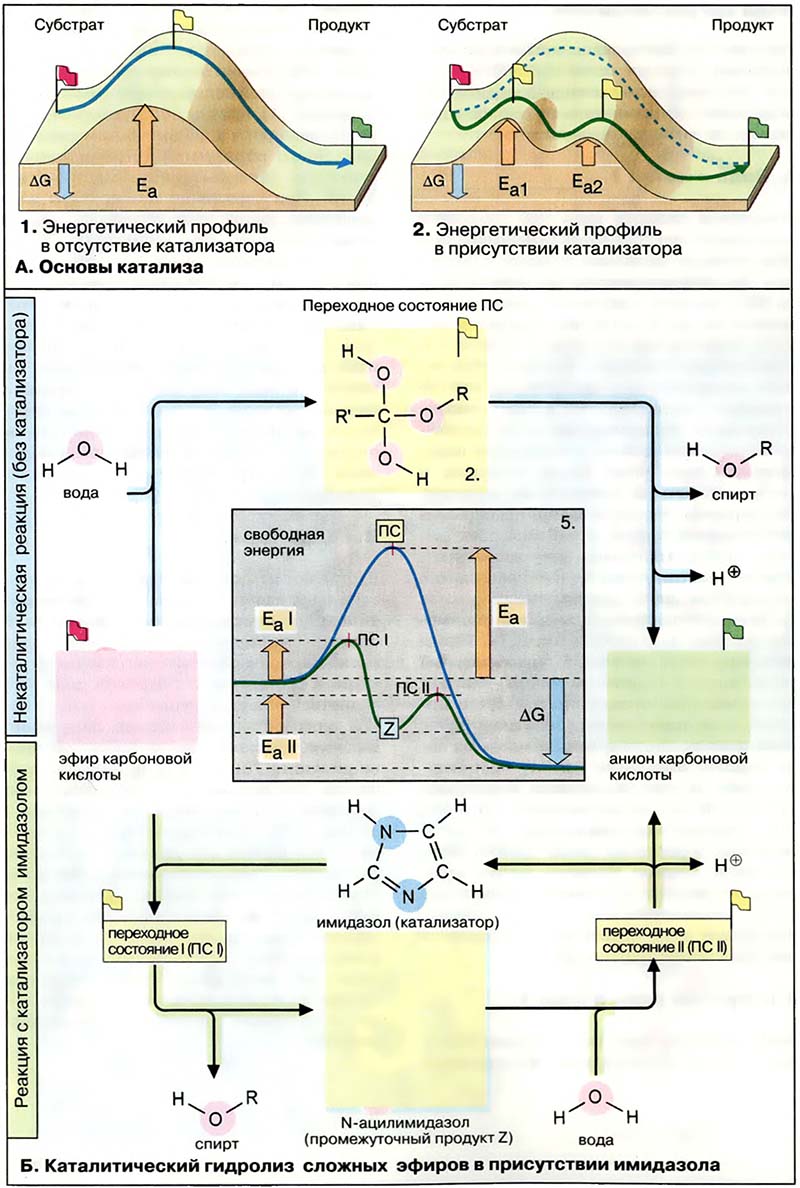
Причиной низкой скорости большинства органических реакций является высокий энергетический барьер (энергия активации, см. Аминокислоты: физические и химические свойства), который должны преодолеть молекулы прежде, чем вступить в реакцию. В водных растворах энергия активации расходуется на разрушение гидратной оболочки молекул реагентов. Часто во время реакции происходит разрушение мезомерных структур, что также требует затрат энергии. Наиболее высокая точка энергетической кривой обычно соответствует энергетически неблагоприятному переходному состоянию (1). Катализатор снижает энергию активациии и направляет реакцию по другому пути (2). Если все переходные состояния характеризуются более низкой энергией активации по сравнению с реакцией в отсутствие катализатора, то альтернативная реакция протекает с более высокой скоростью несмотря на образование большого числа промежуточных продуктов. Поскольку реагенты и продукты реакции в обоих случаях идентичны, реакция, протекающая в присутствии катализатора, не влияет на изменение свободной энергии ΔG. Катализаторы, в том числе ферменты, в принципе не влияют на равновесное состояние реакции (см. Равновесие).
Утверждение о том, что катализатор снижает энергию активации, строго говоря, не корректно, так как реакция в присутствии катализатора не идентична исходной реакции. Просто это совершенно иная реакция, имеющая более низкий активационный барьер.
Утверждение о том, что катализатор снижает энергию активации, строго говоря, не корректно, так как реакция в присутствии катализатора не идентична исходной реакции. Просто это совершенно иная реакция, имеющая более низкий активационный барьер.
Статьи раздела «Катализ»:
- Катализ
- А. Основы катализа
- Б. Каталитический гидролиз сложных эфиров в присутствии имидазола
Структура:
Списки:
Сложность материала:
Величины и единицы:
Книги Список книг
 Gene Control
 Gene Control offers an articulate, current description of how gene expression is controlled in eukaryotes, reviewing and summarizing the extensive ...
 Microarray Image Analysis: An Algorithmic Approach (Chapman & Hall/CRC Computer Science & Data Analysis)
 To harness the high-throughput potential of DNA microarray technology, it is crucial that the analysis stages of the process are decoupled from the ...

 Молекулярная и клеточная биология (комплект из 3 книг)
 В книге известного учёного ФРГ на самом современном уровне обсуждены последние ...