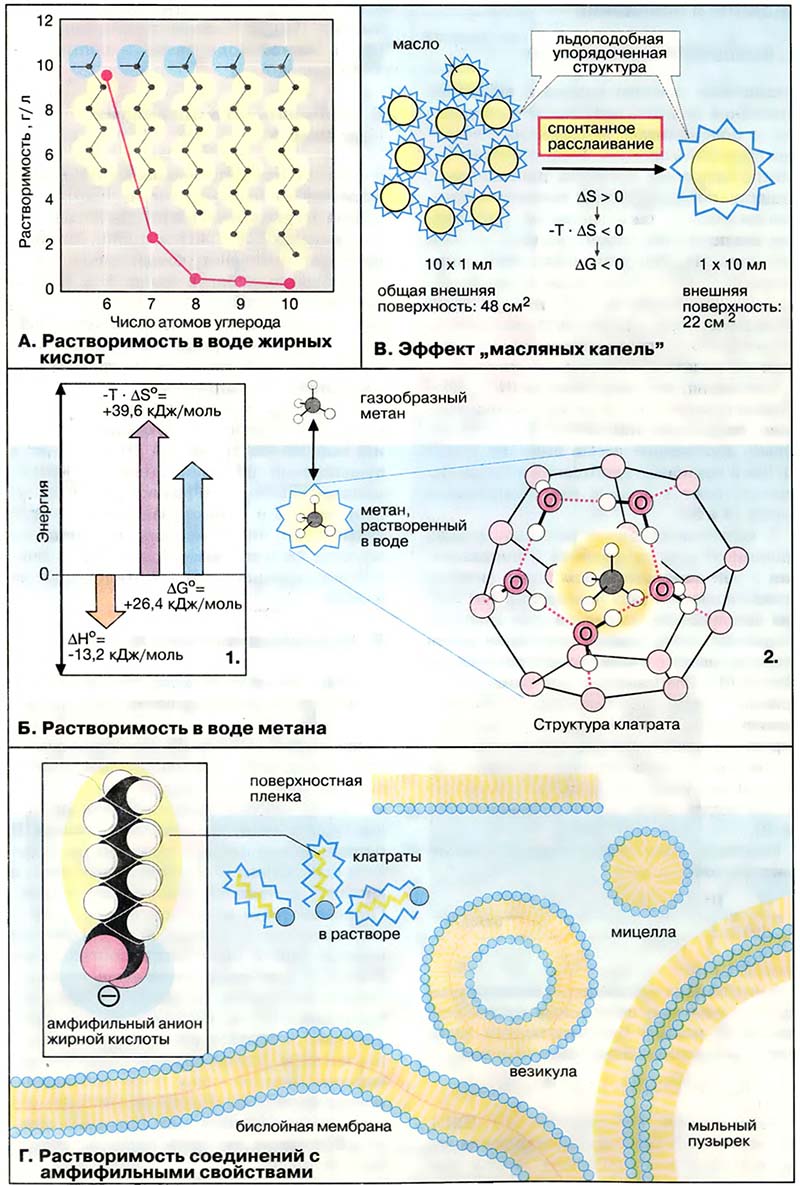
Вещества, имеющие в структуре как полярные, так и неполярные группы, называются амфифильными. К этой группе принадлежат, например, жиры (см. Контроль транскрипции), фосфолипиды и желчные кислоты (см. Фотосинтез: темновые реакции). Вследствие эффекта «масляных капель» (Б) амфифилы при контакте с водой склонны образовывать структуры, у которых площадь контакта неполярной части молекул с водой минимальна. На поверхности воды такие вещества обычно образуют монослойные плёнки, у которых полярные группы ориентированы в воду. Мыльные пузырьки образованы липидными бислоями с тонким наружным слоем воды. В воде амфифилы образуют протяжённые бислойные мембраны или мицеллы, у которых полярные группы ориентированы в воду. По этому принципу построено большинство биологических мембран (см. Биомембраны: структура и функции). Полые мембранные пузырьки носят название везикул. В клетках и крови такие структуры играют ключевую роль при выполнении транспортных функций (см. Транслокация белков. Шапероны, Липопротеины).
Статьи раздела «Гидрофобные взаимодействия»:
- Гидрофобные взаимодействия
- А. Растворимость в воде жирных кислот
- Б. Растворимость в воде метана
- В. Эффект «масляных капель»
- Г. Растворимость соединений с амфифильными свойствами
Структура:
Списки:
Сложность материала:
Величины и единицы:
Книги Список книг

 Нанотехнология белков. Протоколы, оборудование, области применения
 В этой книге, написанной ведущими экспертами, собраны последние достижения в ...
 Биофизика ДНК-актиномициновых нано-комплексов
 В монографии д.б.н., в.н.с. ИБК РАН Н.Л.Векшина на примере актиномицинов ...
 Молекула, жизнь, организм
 Учащиеся, прочитав эту книгу, смогут составить представление о том, что же такое ...