Ферментативный анализ

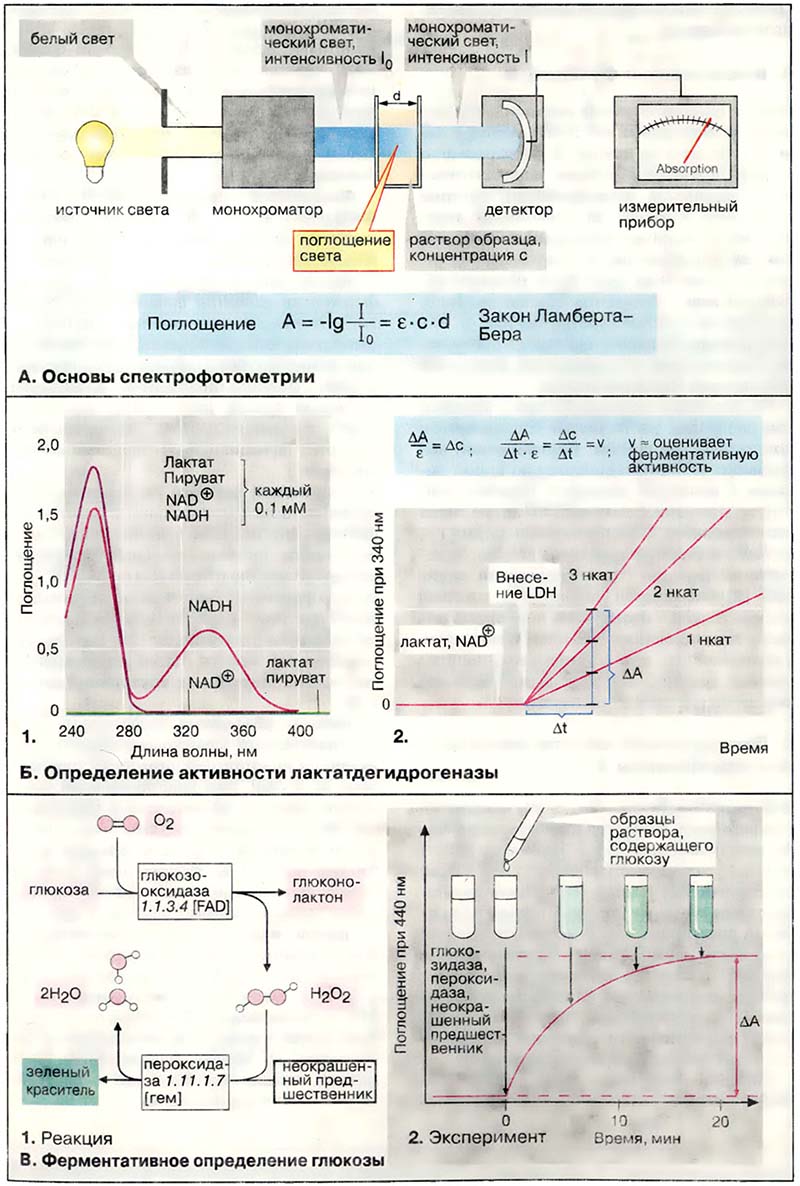
Ферменты играют важную роль в биохимическом анализе. В биологических материалах, например в жидкостях организма, с помощью определения каталитической активности можно обнаружить ферменты в ничтожно малых концентрациях. Ферменты можно использовать как реагенты для определения концентраций метаболитов, например уровня глюкозы в крови (схема В). В большинстве ферментативных анализов применяется фотометрия.

Метаболизм. Ферменты / Ферментативный анализ

Статьи раздела «Ферментативный анализ»:

Следущая статья   |   — Вернуться в раздел


Metals in Medicine / Working from basic chemical principles, Metals in Medicine presents a complete and methodical approach to the topic. Introductory chapters discuss important bonding concepts applicable to metallo-drugs and their biological targets, interactions that exist between the agents and substances in the bioMetals in Medicine
Working from basic chemical principles, Metals in Medicine presents a complete and methodical approach to the topic. Introductory chapters discuss ...
Principles of Biomedical Informatics / Biomedical informatics (BMI) is an extraordinarily broad discipline. In scale, it spans across genes, cells, tissues, organ systems, individual patients, populations, and the world’s medical ecology. It ranges in methodology from hardcore mathematical modeling to descriptive observations that use «sPrinciples of Biomedical Informatics
Biomedical informatics (BMI) is an extraordinarily broad discipline. In scale, it spans across genes, cells, tissues, organ systems, individual ...
Koneman’s Color Atlas and Textbook of Diagnostic Microbiology / Long considered the definitive work in its field, this new edition presents all the principles and practices readers need for a solid grounding in all aspects of clinical microbiology—bacteriology, mycology, parasitology, and virology. Tests are presented according to the Clinical and Laboratory StaKoneman’s Color Atlas and Textbook of Diagnostic Microbiology
Long considered the definitive work in its field, this new edition presents all the principles and practices readers need for a solid grounding in all ...
NMR Studies of Structural Motifs: Protein Folding and Ligand Binding / NMR of Structural Motifs: The agrin G3 domain is critical in development and maintenance of the neuromuscular junction. G3 binds -dystroglycan and initiates acetylcholine receptor clustering on myotube membranes. Using NMR spectroscopy, we show both active B8 and inactive B0 isoforms binding sialic NMR Studies of Structural Motifs: Protein Folding and Ligand Binding
NMR of Structural Motifs: The agrin G3 domain is critical in development and maintenance of the neuromuscular junction. G3 binds -dystroglycan and ...