Транспорт газов

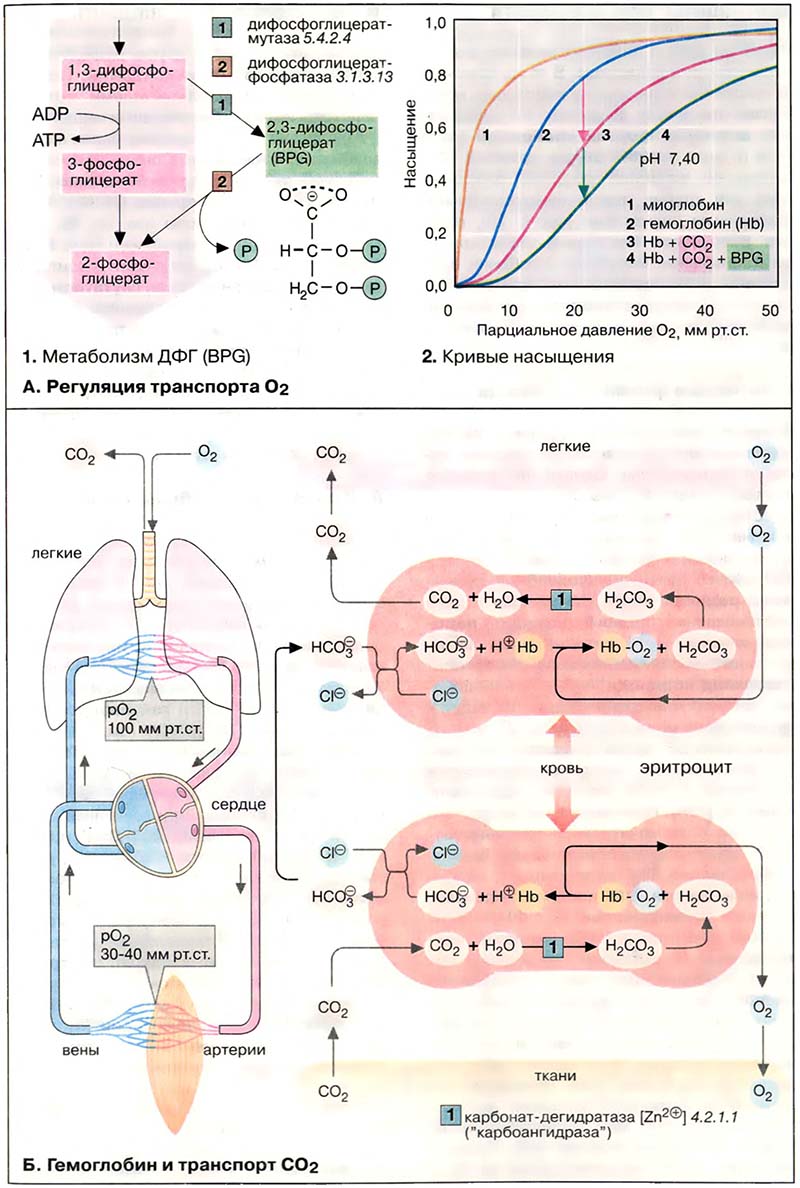
Большинство тканей для поддержания своего окислительного потенциала постоянно снабжаются молекулярным кислородом (O2). Из-за плохой растворимости O2 связывается и транспортируется в крови гемоглобином (см. Гемоглобин). Свойства Hb таковы, что он не только обеспечивает транспорт кислорода, но и создаёт благоприятные условия для связывания O2 в лёгких и передачи его тканям.

Ткани и органы. Кровь / Транспорт газов

Статьи раздела «Транспорт газов»:

Следущая статья   |   — Вернуться в раздел


Molecular Biology of the Cell: The Problems Book / The Problems Book helps students appreciate the ways in which experiments and simple calculations can lead to an understanding of how cells work by introducing the experimental foundation of cell and molecular biology. Each chapter will review key terms, test for understanding basic concepts, and poMolecular Biology of the Cell: The Problems Book
The Problems Book helps students appreciate the ways in which experiments and simple calculations can lead to an understanding of how cells work by ...
Афинная модификация биополимеров / Монография посвящена одному из самых информативных методов физико-химической биологии — афинной модификации белков, нуклеиновых кислот и нуклеопротеидов. В ней излагаются теоретические основы метода и рассматриваются особенности приложения метода к ряду наиболее интенсивно изучаемых с его помощью биАфинная модификация биополимеров
Монография посвящена одному из самых информативных методов физико-химической ...
Biomolecular Crystallography: Principles, Practice, and Application to Structural Biology / Synthesizing over thirty years of advances into a comprehensive textbook, Biomolecular Crystallography describes the fundamentals, practices, and applications of protein crystallography. Deftly illustrated in full-color by the author, the text describes mathematical and physical concepts in accessibBiomolecular Crystallography: Principles, Practice, and Application to Structural Biology
Synthesizing over thirty years of advances into a comprehensive textbook, Biomolecular Crystallography describes the fundamentals, practices, and ...
Histone H1 glycation and rutin metabolites as glycation inhibitors: Nuclear protein glycation in vivo and novel natural product AGE inhibitors / Protein glycation, induced by hyperglycemia, is implicated in the appearance of diabetic complications and the aging process. Glycation involves the non-enzymatic reaction between sugars and protein amino groups that lead to formation of advanced glycation end products (AGEs). When aminoguanidine, aHistone H1 glycation and rutin metabolites as glycation inhibitors: Nuclear protein glycation in vivo and novel natural product AGE inhibitors
Protein glycation, induced by hyperglycemia, is implicated in the appearance of diabetic complications and the aging process. Glycation involves the ...