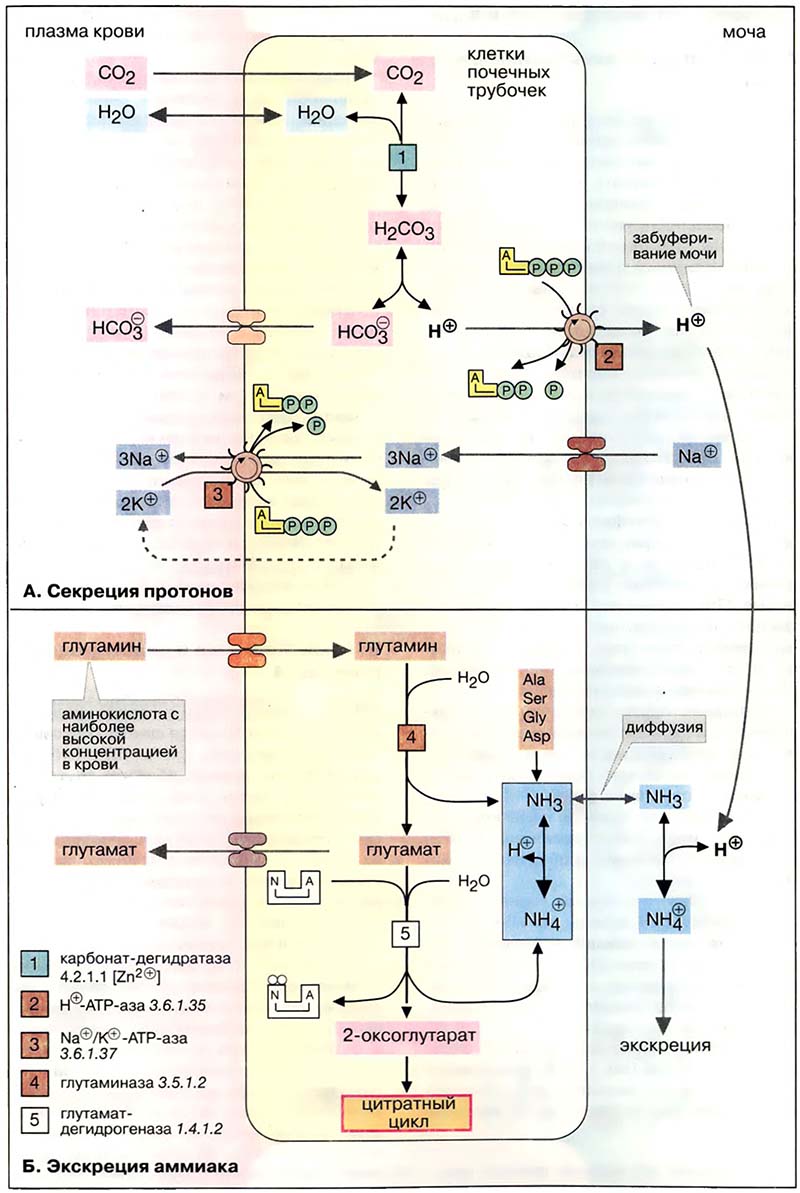
Клетки дистального отдела нефрона (извитого канальца и собирательных почечных трубочек) переносят протоны (Н+) из крови в просвет канальца (в мочу). Секреция идёт против градиента концентрации, поскольку концентрация протонов в моче в 1 000 раз превышает концентрацию в крови. При этом из крови в клетки почечных трубочек диффундирует диоксид углерода (CO2), который в цитоплазме гидратируется при участии карбонат-дегидратазы (карбоангидразы) [1] с образованием H2CO3, диссоциирующей на ион бикарбоната (HCO3-) и протон.
Протон секретируется из цитоплазмы в просвет канальца мембранной транспортной АТФ-зависимой системой [2], а ион бикарбоната всасывается через базолатеральную мембрану обратно в кровь. Для сохранения электронейтральности из канальца в кровь за счёт реабсорбции переносятся ионы Na+. Суммарный процесс состоит в переносе протонов из крови в обмен на ионы Na+. Тем самым почки принимают участие в поддержании стабильного pH плазмы крови (равновесия CO2/HCO3-) (см. Кислотно-основной баланс).
Ежедневно с мочой секретируется примерно 60 ммолей протонов. Однако в моче большая часть протонов нейтрализуется буферными системами, поэтому pH мочи лежит в слабокислой области (примерно до 4,8). Наиболее важной буферной системой является фосфатная (HPO42-/H2PO4-). Определённый вклад в поддержание величины pH вносит аммиак за счёт образования ионов аммония. В то время как экскреция фосфата зависит от количества фосфора, поступившего с пищей, выведение аммиака варьирует в широких пределах в зависимости от метаболических потребностей организма.
Протон секретируется из цитоплазмы в просвет канальца мембранной транспортной АТФ-зависимой системой [2], а ион бикарбоната всасывается через базолатеральную мембрану обратно в кровь. Для сохранения электронейтральности из канальца в кровь за счёт реабсорбции переносятся ионы Na+. Суммарный процесс состоит в переносе протонов из крови в обмен на ионы Na+. Тем самым почки принимают участие в поддержании стабильного pH плазмы крови (равновесия CO2/HCO3-) (см. Кислотно-основной баланс).
Ежедневно с мочой секретируется примерно 60 ммолей протонов. Однако в моче большая часть протонов нейтрализуется буферными системами, поэтому pH мочи лежит в слабокислой области (примерно до 4,8). Наиболее важной буферной системой является фосфатная (HPO42-/H2PO4-). Определённый вклад в поддержание величины pH вносит аммиак за счёт образования ионов аммония. В то время как экскреция фосфата зависит от количества фосфора, поступившего с пищей, выведение аммиака варьирует в широких пределах в зависимости от метаболических потребностей организма.
Статьи раздела «Экскреция протонов и аммиака»:
- Экскреция протонов и аммиака
- А. Секреция протонов
- Б. Экскреция аммиака
Структура:
Списки:
Сложность материала:
Величины и единицы:
Книги Список книг
 Клеточные механизмы токсичности аммиака
 В настоящей книге авторы попытались кратко изложить исторически сложившиеся и ...
 Review of Medical Microbiology and Immunology
 To put your preparation for USMLE Step 1 and course exams on the fast track, only one resource will do: «Review of Medical Microbiology and ...
 Атлас. Морфология крахмала и крахмалопродуктов
 В атласе приведены данные о морфологической характеристике нативных крахмалов: ...
 Инфракрасные спектры сложных молекул
 В книге даётся богатейший, хорошо систематизированный справочный материал по ...