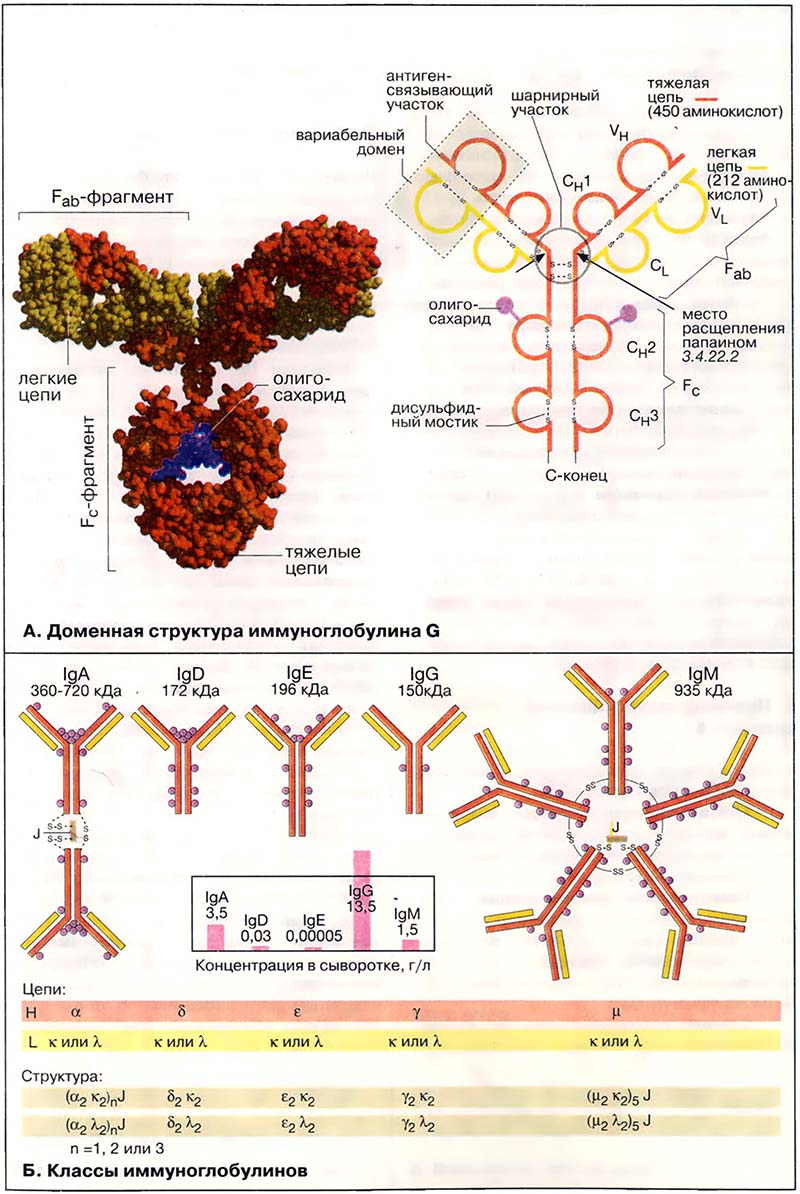
Иммуноглобулины человека по структуре тяжёлых цепей делятся на пять классов. Различия между IgA (с двумя подклассами), IgD, IgE, IgG (с четырьмя подклассами) и IgM определяются Н-цепями, которые обозначаются греческими буквами — α, δ, ε, γ и μ. L-Цепи имеют только две разновидности (κ и λ). IgM могут существовать в различных формах. Секретируемые IgM состоят из пяти взаимосвязанных димеров, IgA могут быть образованы из одного, двух или трёх димеров. Олигомерные IgM и IgA удерживаются вместе благодаря связывающему J-пептиду (от англ. joining).
Иммуноглобулины всех пяти классов являются секретируемыми белками. Они поставляются в кровь зрелыми B-клетками (плазматическими клетками, см. Иммунный ответ). Ранние варианты IgM и IgD найдены также в виде интегральных мембранных белков на поверхности B-клеток.
Антитела имеют различные функции. При контакте с чужеродным антигеном первыми образуются IgM-антитела. Ранние формы IgM связаны с поверхностью B-клеток (см. Белки главного комплекса гисто-совместимости), более поздние формы секретируются в виде пентамеров плазматическими клетками. Антитела IgM особенно активны против микроорганизмов. В количественном отношении превалируют антитела IgG (см. таблицу сывороточных концентраций белков). Они находятся в крови и в интерстициальной жидкости; с помощью рецепторов они могут также проходить в плаценту и вследствие этого переноситься от матери к плоду. IgA обнаруживаются преимущественно в кишечном тракте и секретах. IgE присутствуют в плазме здорового человека лишь в незначительных концентрациях. Повышение уровня IgE наблюдается при аллергических реакциях и паразитарных инфекциях (lgE является атопическим (кожно-сенсибилизирующим) иммуноглобулином (реагином, см. Белки плазмы крови)). Количества в плазме IgD, функция которого ещё не выяснена, также весьма малы.
Иммуноглобулины всех пяти классов являются секретируемыми белками. Они поставляются в кровь зрелыми B-клетками (плазматическими клетками, см. Иммунный ответ). Ранние варианты IgM и IgD найдены также в виде интегральных мембранных белков на поверхности B-клеток.
Антитела имеют различные функции. При контакте с чужеродным антигеном первыми образуются IgM-антитела. Ранние формы IgM связаны с поверхностью B-клеток (см. Белки главного комплекса гисто-совместимости), более поздние формы секретируются в виде пентамеров плазматическими клетками. Антитела IgM особенно активны против микроорганизмов. В количественном отношении превалируют антитела IgG (см. таблицу сывороточных концентраций белков). Они находятся в крови и в интерстициальной жидкости; с помощью рецепторов они могут также проходить в плаценту и вследствие этого переноситься от матери к плоду. IgA обнаруживаются преимущественно в кишечном тракте и секретах. IgE присутствуют в плазме здорового человека лишь в незначительных концентрациях. Повышение уровня IgE наблюдается при аллергических реакциях и паразитарных инфекциях (lgE является атопическим (кожно-сенсибилизирующим) иммуноглобулином (реагином, см. Белки плазмы крови)). Количества в плазме IgD, функция которого ещё не выяснена, также весьма малы.
Статьи раздела «Антитела»:
- А. Доменная структура иммуноглобулина G
- Б. Классы иммуноглобулинов
Структура:
Списки:
Сложность материала:
Величины и единицы:
Книги Список книг
 Введение в молекулярную биологию
 Задача предлагаемой книги состоит в ознакомлении читателей с важнейшими фактами ...
 Молекулярная биология процессов развития
 Книга представляет собой полную сводку современных знаний о молекулярных ...
 Biotechnology Annual R Volume 14 (Biotechnology Annual Review) (Biotechnology Annual Review)
 Biotechnology is a diverse, complex, and rapidly evolving field. Students and experienced researchers alike face the challenges of staying on top of ...
 Geobiology: Objectives, Concepts, Perspectives, First Edition
 Book DescriptionGeobiology is an exciting and rapidly developing research discipline that opens new perspectives in understanding Earth as a system. ...