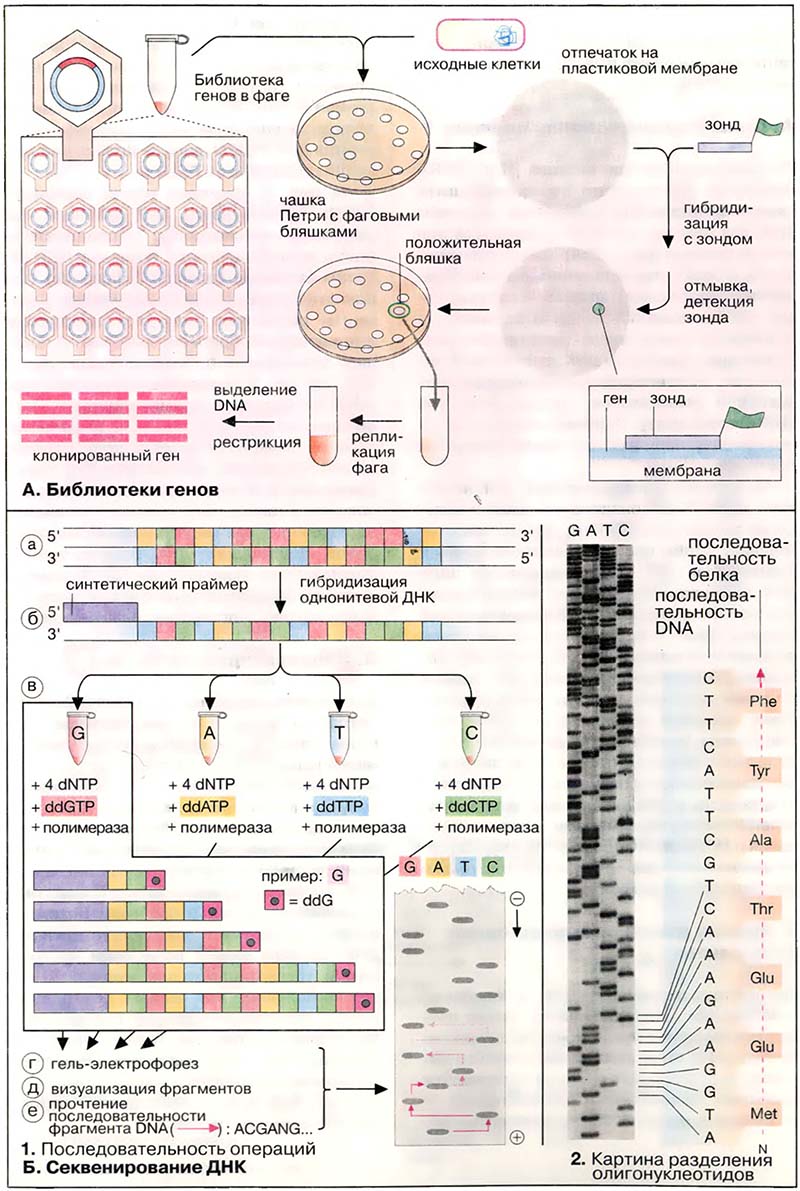
Современным методом определения нуклеотидной последовательности ДНК является метод обрыва цепи (англ. chain termination method). Прежде всего фрагмент ДНК клонируют в фаге М13 (см. Вирусы), из которого легко выделяют однонитевую ДНК (а). Её гибридизуют с короткой ДНК, называемой праймером, которая связывается с 3′-концом однонитевой ДНК (б). Затем к полученной матрице добавляют четыре дезоксирибонуклеозидтрифосфата дНТФ (dNTP): дАТФ (dATP), дГТФ (dGTP), дТГФ (dTGP) и дЦТФ (dCTP). Кроме дезоксирибонуклеозидтрифосфатов в реакционную смесь добавляют один из четырёх дидезоксирибонуклеозидтрифосфатов [ддНТФ (ddNTP)] (см. схему). Затем с помощью ДНК-полимеразы ведут синтез второй (комплементарной) цепи ДНК.
Остановка синтеза (обрыв цепи) будет происходить всякий раз, когда вместо дНТФ в растущую цепь ДНК будет встраиваться соответствующий ему ддНТФ. На схеме принцип метода демонстрируется на примере с ддГТФ. В этом случае образуются фрагменты, которые включают праймер плюс 3, 6, 8, 13 или 14 других нуклеотидов. Для определения последовательности нуклеотидов необходимо поставить 4 отдельные реакции в присутствии каждого из четырёх ддНТФ (в). Затем четыре пробы вносят в соседние лунки пластины геля и проводят гель-электрофорез (г) (см. Методы выделения и анализа белков). Длина пробега каждого компонента обратно пропорциональна длине цепи.
Как только фрагменты ДНК визуализированы (д), нуклеотидную последовательность можно прочесть прямо в геле снизу по направлению к старту в соответствие с очерёдностью, в которой фрагменты располагаются на отдельных «дорожках» (е). Реальная электрофореграмма с четырьмя дорожками приведена на рис. 2. При оптимальных условиях с помощью метода обрыва цепи можно в одном эксперименте определить строение фрагмента, включающего сотни нуклеотидов.
Остановка синтеза (обрыв цепи) будет происходить всякий раз, когда вместо дНТФ в растущую цепь ДНК будет встраиваться соответствующий ему ддНТФ. На схеме принцип метода демонстрируется на примере с ддГТФ. В этом случае образуются фрагменты, которые включают праймер плюс 3, 6, 8, 13 или 14 других нуклеотидов. Для определения последовательности нуклеотидов необходимо поставить 4 отдельные реакции в присутствии каждого из четырёх ддНТФ (в). Затем четыре пробы вносят в соседние лунки пластины геля и проводят гель-электрофорез (г) (см. Методы выделения и анализа белков). Длина пробега каждого компонента обратно пропорциональна длине цепи.
Как только фрагменты ДНК визуализированы (д), нуклеотидную последовательность можно прочесть прямо в геле снизу по направлению к старту в соответствие с очерёдностью, в которой фрагменты располагаются на отдельных «дорожках» (е). Реальная электрофореграмма с четырьмя дорожками приведена на рис. 2. При оптимальных условиях с помощью метода обрыва цепи можно в одном эксперименте определить строение фрагмента, включающего сотни нуклеотидов.
Статьи раздела «Секвенирование ДНК»:
- А. Библиотеки
- Б. Секвенирование ДНК
Структура:
Списки:
Сложность материала:
Величины и единицы:
Книги Список книг
 Клеточные механизмы токсичности аммиака
 В настоящей книге авторы попытались кратко изложить исторически сложившиеся и ...

 Физика белка. Курс лекций с цветными и стереоскопическими иллюстрациями и задачами
 Физика белка простирается от классификации и принципов устройства белков ...
 Introductory Chemistry: Concepts and Critical Thinking (6th Edition)
 Introductory Chemistry: Concepts and Critical Thinking, Sixth Edition is a comprehensive learning system that offers print and media resources as well ...