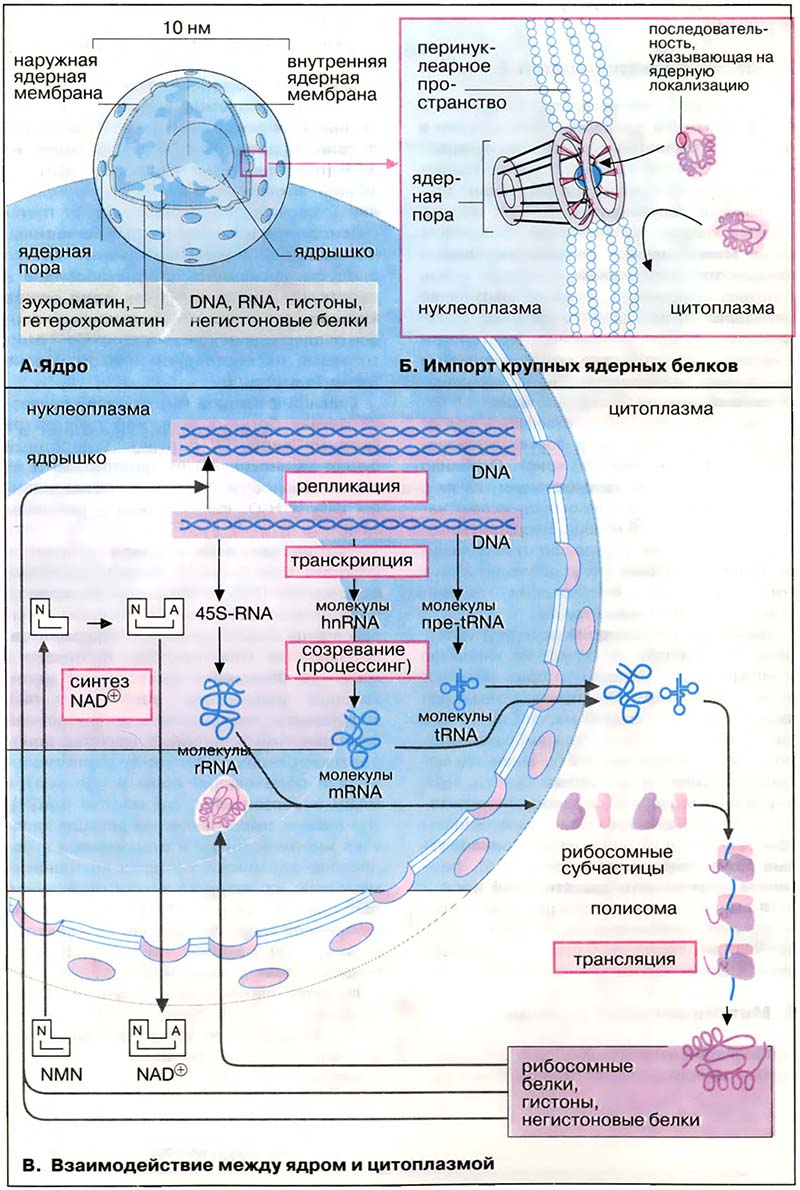
Ядро — наиболее крупная (диаметром около 10 мкм) видимая в оптический микроскоп органелла эукариотической клетки. Оно отделено от остальной клетки оболочкой, состоящей из внутренней и внешней ядерных мембран.
Область между двумя ядерными мембранами называется перинуклеарным пространством. Внешняя ядерная мембрана усыпана рибосомами и переходит в шероховатый эндоплазматический ретикулум. Внутренняя ядерная мембрана выстлана специальными белками (ламином и др.), которые служат для закрепления ядерных структур (ядерная пластинка).
В ядре расположена почти вся ДНК (DNA) клетки. Эта ДНК является носителем генетической информации и главным местом её репликации и экспрессии. В интерфазе (фазы между делениями клетки) большая часть ДНК в ядре присутствует в виде гетерохроматина, то есть плотно упакованной ДНК, ассоциированной с РНК (RNA) и белками. Менее плотно упакованная ДНК называется эухроматином; это место активной транскрипции ДНК в РНК (RNA). Ядро часто содержит ядрышко, а иногда и несколько ядрышек. Во время деления клеток структура ядра разрушается. Хроматин организуется в хромосомы, то есть в высшей степени конденсированные формы молекул ДНК, видимые в оптический микроскоп.
Область между двумя ядерными мембранами называется перинуклеарным пространством. Внешняя ядерная мембрана усыпана рибосомами и переходит в шероховатый эндоплазматический ретикулум. Внутренняя ядерная мембрана выстлана специальными белками (ламином и др.), которые служат для закрепления ядерных структур (ядерная пластинка).
В ядре расположена почти вся ДНК (DNA) клетки. Эта ДНК является носителем генетической информации и главным местом её репликации и экспрессии. В интерфазе (фазы между делениями клетки) большая часть ДНК в ядре присутствует в виде гетерохроматина, то есть плотно упакованной ДНК, ассоциированной с РНК (RNA) и белками. Менее плотно упакованная ДНК называется эухроматином; это место активной транскрипции ДНК в РНК (RNA). Ядро часто содержит ядрышко, а иногда и несколько ядрышек. Во время деления клеток структура ядра разрушается. Хроматин организуется в хромосомы, то есть в высшей степени конденсированные формы молекул ДНК, видимые в оптический микроскоп.
Статьи раздела «Ядро»:
Структура:
Списки:
Сложность материала:
Величины и единицы:
Книги Список книг
 Открытие основных законов жизни
 В книге изложены история развития и основные достижения молекулярной биологии — ...
 Введение в молекулярную биологию
 Задача предлагаемой книги состоит в ознакомлении читателей с важнейшими фактами ...
 Нелинейная динамика взаимодействующих популяций
 Проведён анализ режимов динамического поведения в системах нескольких ...
 Introductory Microbiology
 As a component of biology, Plant Pathology enjoyed a prestigious position and its applied aspects; plant disease management was an integral part of ...