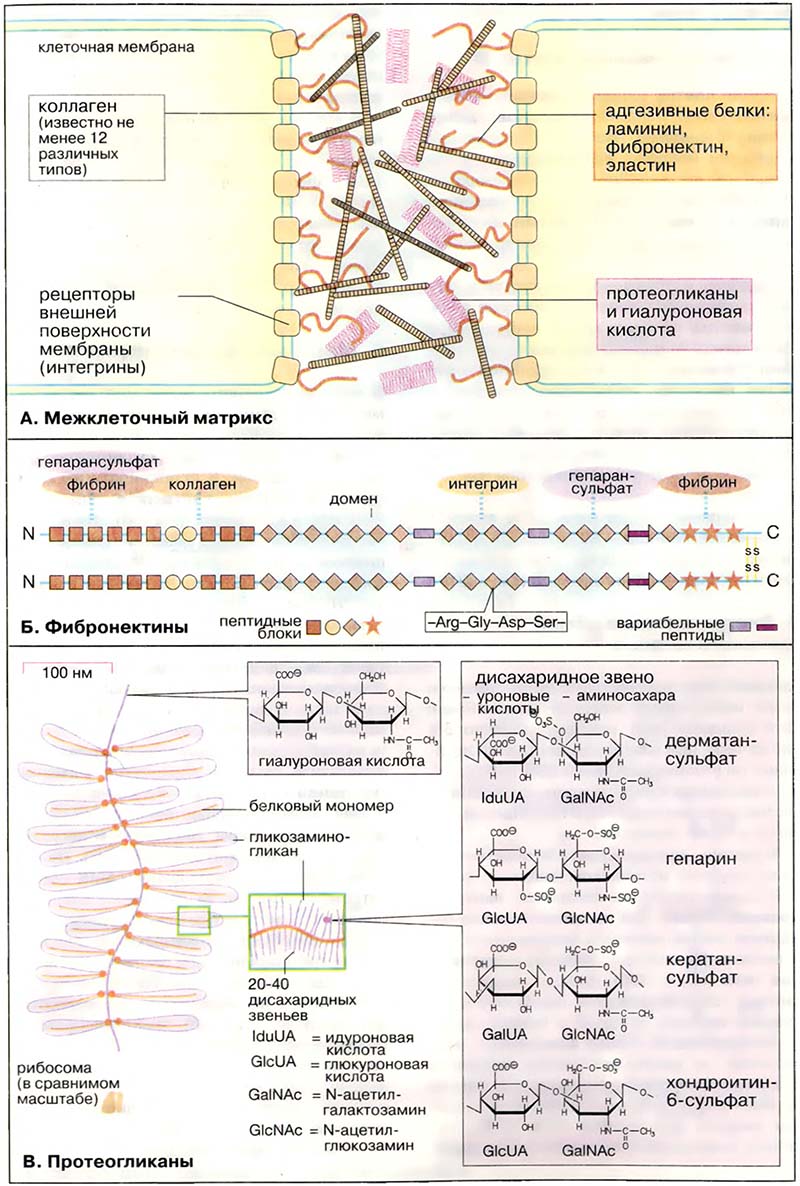
Типичными представителями адгезивных белков являются фибронектины. Молекулы фибронектинов представляют собой димеры сходных между собой полипептидных цепей (250 кДа), связанных дисульфидными связями. Субъединицы подразделяются на ряд различных доменов, способных связываться с клеточными рецепторами, коллагенами, фибрином и протеогликанами. Такая особенность строения фибронектинов придаёт им свойство «молекулярного клея».
Фибронектины имеют модульную структуру. Они состоят из трёх пептидных модулей, которые многократно повторяются (структурные и функциональные домены включают один или несколько таких повторов). Каждый из более чем 50 функциональных блоков кодируется в гене фибронектина одним экзоном. При альтернативном сплайсинге транскриптов РНК гена фибронектина (см. Созревание РНК) образуются белки различного состава. Модуль, ответственный за связывание фибронектина с клетками, включает характерную аминокислотную последовательность -Arg-Gly-Asp-Ser-. Этот блок обеспечивает связывание фибронектина с клеточными рецепторами, интегринами.
Фибронектины имеют модульную структуру. Они состоят из трёх пептидных модулей, которые многократно повторяются (структурные и функциональные домены включают один или несколько таких повторов). Каждый из более чем 50 функциональных блоков кодируется в гене фибронектина одним экзоном. При альтернативном сплайсинге транскриптов РНК гена фибронектина (см. Созревание РНК) образуются белки различного состава. Модуль, ответственный за связывание фибронектина с клетками, включает характерную аминокислотную последовательность -Arg-Gly-Asp-Ser-. Этот блок обеспечивает связывание фибронектина с клеточными рецепторами, интегринами.
Статьи раздела «Состав межклеточного матрикса»:
- А. Межклеточный матрикс
- Б. Фибронектины
- В. Протеогликаны
Структура:
Списки:
Сложность материала:
Величины и единицы:
Книги Список книг
 Биокатализ и биокатализаторы. Исторический очерк
 Книга посвящена истории возникновения и развития двух основных проблем ...
 Биофизическая химия (комплект из 2 книг)
 В трёхтомном издании, написанном учёными из США, на самом современном уровне ...
 Структура и стабильность биологических макромолекул
 В книге рассмотрены строение и свойства биополимеров — в основном белков. Такие ...
