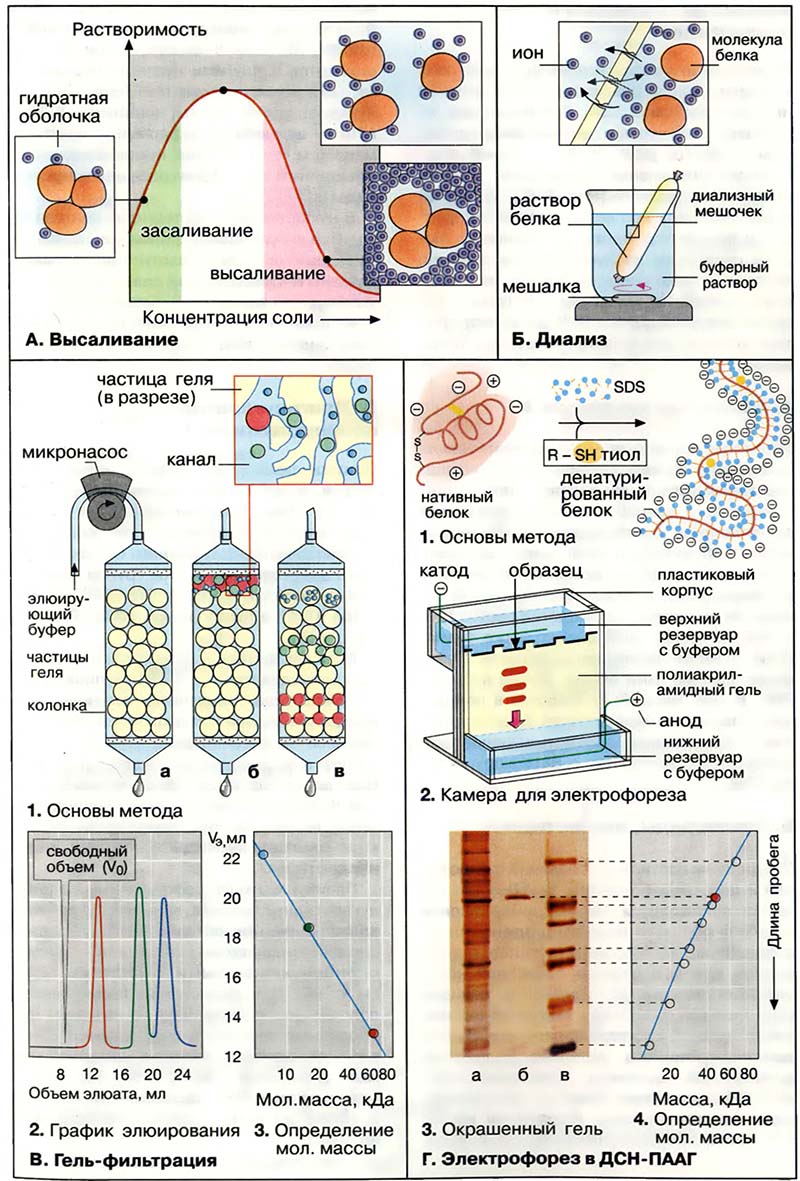
Б. Диализ

Для отделения низкомолекулярных примесей или замены состава среды используют диализ. Метод основан на том, что молекулы белка из-за своих размеров не могут проходить через полупроницаемые мембраны, в то время как низкомолекулярные вещества равномерно распределяются между объёмом, ограниченным мембраной, и окружающим раствором. После многократной замены внешнего раствора состав среды в диализном мешочке (концентрация солей, величина pH и др.) будет тот же, что и в окружающем растворе.

Биомолекулы. Пептиды и белки / Методы выделения и анализа белков

Статьи раздела «Методы выделения и анализа белков»:

Следущая статья   |   — Вернуться в раздел


Cell Biology: With STUDENT CONSULT Online Access / A masterful, richly illustrated introduction to the cell biology that you need to know.Cell Biology: With STUDENT CONSULT Online Access
A masterful, richly illustrated introduction to the cell biology that you need to know.
Review of Medical Microbiology and Immunology / To put your preparation for USMLE Step 1 and course exams on the fast track, only one resource will do: «Review of Medical Microbiology and Immunology». Completely updated throughout, the Eleventh Edition presents a high-yield review of the basic and clinical aspects of bacteriology, virology, mycolReview of Medical Microbiology and Immunology
To put your preparation for USMLE Step 1 and course exams on the fast track, only one resource will do: «Review of Medical Microbiology and ...
Stress — From Molecules to Behavior: A Comprehensive Analysis of the Neurobiology of Stress Responses / This book comprehensively covers the molecular basis of stress responses of the nervous system, providing a unique and fundamental insight into the molecular, physiological and behavioral basis of the stress response of a whole organism. Edited by leading experts in the field and summarizing the latStress — From Molecules to Behavior: A Comprehensive Analysis of the Neurobiology of Stress Responses
This book comprehensively covers the molecular basis of stress responses of the nervous system, providing a unique and fundamental insight into the ...
NMR Studies of Structural Motifs: Protein Folding and Ligand Binding / NMR of Structural Motifs: The agrin G3 domain is critical in development and maintenance of the neuromuscular junction. G3 binds -dystroglycan and initiates acetylcholine receptor clustering on myotube membranes. Using NMR spectroscopy, we show both active B8 and inactive B0 isoforms binding sialic NMR Studies of Structural Motifs: Protein Folding and Ligand Binding
NMR of Structural Motifs: The agrin G3 domain is critical in development and maintenance of the neuromuscular junction. G3 binds -dystroglycan and ...