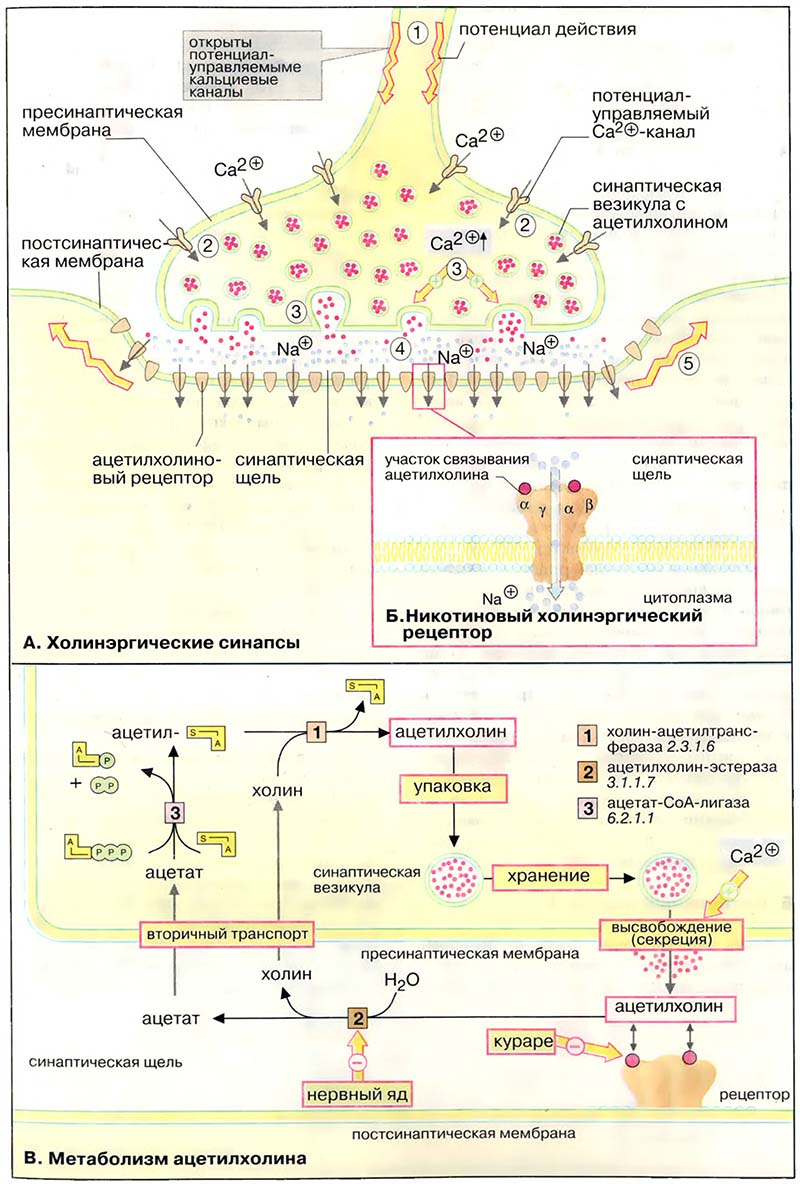
Б. Никотиновый холинэргический рецептор

Наиболее детально изучен рецептор ацетилхолина, активируемый никотином. Это трансмембранный комплекс из пяти субъединиц (α2βδγ, 250-270 кДа), образующий лиганд-активируемый (хемовозбудимый) ионный канал, проницаемый для ионов Na+ и K+. Участки связывания ацетилхолина локализованы на внеклеточной части α-субъединиц. При связывании лиганда в центре молекулы формируется трансмембранный канал, входное отверстие которого имеет форму воронки диаметром около 2 нм. Предполагается, что в формировании канала принимают участие все пять субъединиц. Канал открывается на короткое время для прохождения ионов Na+ и K+. Считается, что открывание и закрывание канала происходит в результате аллостерических изменений в заряженных участках полипептидных цепей молекулы рецептора.

Рецептор может связывать различные лекарственные вещества: например, никотин действует как агонист ацетилхолина.

Ткани и органы. Нервная ткань / Синапсы

Статьи раздела «Синапсы»:

Следущая статья   |   — Вернуться в раздел


Role of TCF in body axis formation: Discovery of a Dual Action of XTCF-3 in Xenopus Body Axis Formation / A novel role of TCF family in body axis formation. Revolutionary high impact discoveries are described, elucidating the missing link in the Wnt pathway and protein-TCF combinations with dual functions. By studying the primary axis formation of Xenopus laevis, it was firstly shown that, in combinatioRole of TCF in body axis formation: Discovery of a Dual Action of XTCF-3 in Xenopus Body Axis Formation
A novel role of TCF family in body axis formation. Revolutionary high impact discoveries are described, elucidating the missing link in the Wnt ...
Histone H1 glycation and rutin metabolites as glycation inhibitors: Nuclear protein glycation in vivo and novel natural product AGE inhibitors / Protein glycation, induced by hyperglycemia, is implicated in the appearance of diabetic complications and the aging process. Glycation involves the non-enzymatic reaction between sugars and protein amino groups that lead to formation of advanced glycation end products (AGEs). When aminoguanidine, aHistone H1 glycation and rutin metabolites as glycation inhibitors: Nuclear protein glycation in vivo and novel natural product AGE inhibitors
Protein glycation, induced by hyperglycemia, is implicated in the appearance of diabetic complications and the aging process. Glycation involves the ...
Molecular Biology of the Cell: The Problems Book / The Problems Book helps students appreciate the ways in which experiments and simple calculations can lead to an understanding of how cells work by introducing the experimental foundation of cell and molecular biology. Each chapter will review key terms, test for understanding basic concepts, and poMolecular Biology of the Cell: The Problems Book
The Problems Book helps students appreciate the ways in which experiments and simple calculations can lead to an understanding of how cells work by ...
Physical Properties of Macromolecules / Explains and analyzes polymer physical chemistry research methods and experimental data Taking a fresh approach to polymer physical chemistry, Physical Properties of Macromolecules integrates the two foundations of physical polymer science, theory and practice. It provides the tools to understand poPhysical Properties of Macromolecules
Explains and analyzes polymer physical chemistry research methods and experimental data Taking a fresh approach to polymer physical chemistry, ...