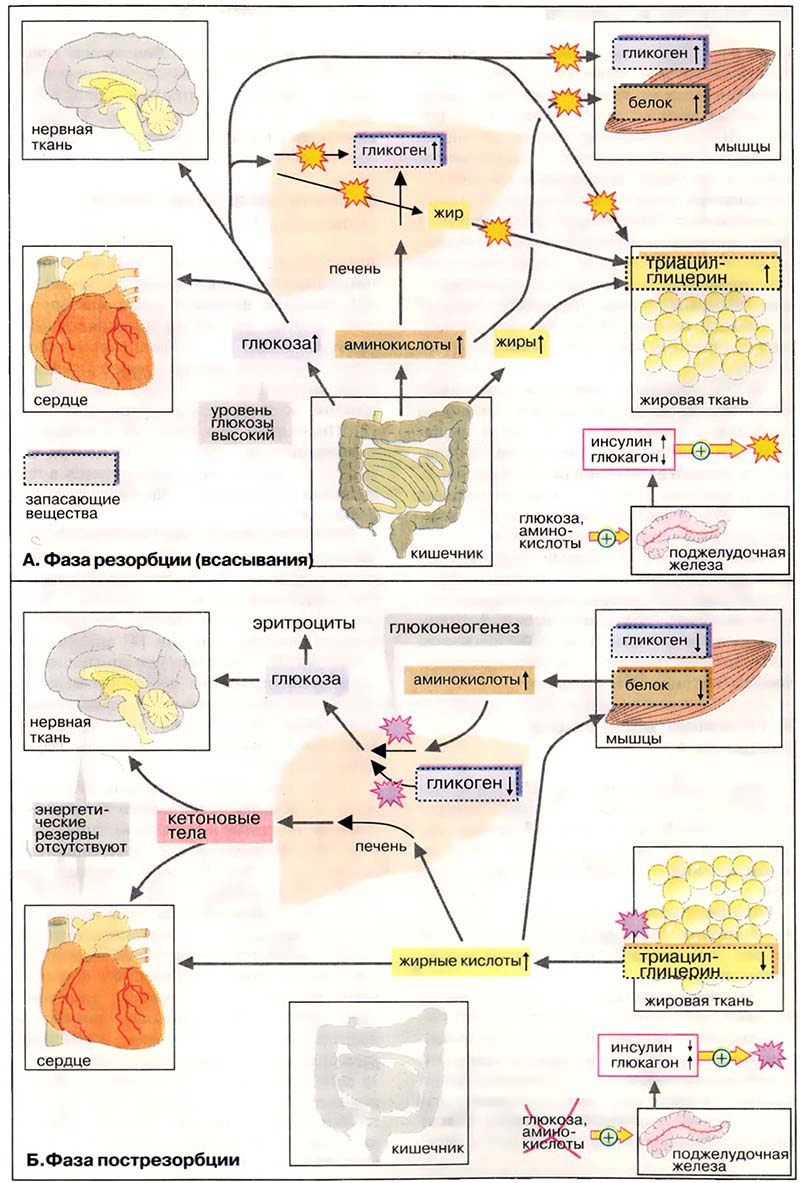
Фаза резорбции (всасывания) начинается непосредственно с приёмом пищи и длится примерно 2-4 ч. За счёт переваривания пищи в плазме крови временно увеличивается концентрация глюкозы, аминокислот и жиров (триглицеринов).
Поджелудочная железа отвечает на это изменением выброса гормонов: увеличением секреции инсулина и уменьшением секреции глюкагона. Увеличение соотношения инсулин/глюкагон в сочетании с богатыми энергией субстратами стимулирует переход тканей (особенно печени, мышечной и жировой тканей) в анаболическую фазу.
В печени из поступающих субстратов синтезируются гликоген и жиры. Гликоген депонируется в печени, жиры в виде липопротеинов очень низкой плотности [ЛОНП (VLDL)] поступают в кровь.
В мышечной ткани также за счёт глюкозы пополняется запас гликогена, а из аминокислот синтезируются белки.
В жировую ткань жиры поступают из печени и желудочно-кишечного тракта (в составе липопротеинов), а затем депонируются в виде жировых капель.
Сердце и нервная ткань используют глюкозу в качестве источника энергии. Клетки сердечной мышцы являются в известном смысле «всеядными», так как они могут получать энергию и из других субстратов.
Статьи раздела «Компенсаторные функции печени»:
- Компенсаторные функции печени
- А. Фаза резорбции
- Б. Фаза пострезорбции
Структура:
Списки:
Сложность материала:
Величины и единицы:
Книги Список книг
 Principles of Biomedical Informatics
Biomedical informatics (BMI) is an extraordinarily broad discipline. In scale, it spans across genes, cells, tissues, organ systems, individual ...
 Koneman’s Color Atlas and Textbook of Diagnostic Microbiology
Long considered the definitive work in its field, this new edition presents all the principles and practices readers need for a solid grounding in all ...
 Biomolecular Crystallography: Principles, Practice, and Application to Structural Biology
Synthesizing over thirty years of advances into a comprehensive textbook, Biomolecular Crystallography describes the fundamentals, practices, and ...
 Stress — From Molecules to Behavior: A Comprehensive Analysis of the Neurobiology of Stress Responses
This book comprehensively covers the molecular basis of stress responses of the nervous system, providing a unique and fundamental insight into the ...