Кровь: состав и функции

Ткани и органы. Кровь
Кровь: состав и функции

Кровь человека составляет примерно 8 % от массы тела. Кровь состоит из клеток, клеточных фрагментов и водного раствора, плазмы. Доля клеточных элементов в общем объёме называется гематокритом и составляет примерно ...

 
А. Функции крови

Кровь осуществляет в организме различные функции. Она является транспортным средством, поддерживает постоянство «внутренней среды» организма (гомеостаз) и играет главную роль в защите от чужеродных веществ ...

А.	Функции крови
Б. Клетки крови

Нерастворимыми элементами крови являются эритроциты, лейкоциты и тромбоциты. Ввиду особой важности эритроцитов их биохимические характеристики рассмотрены более подробно: Гемоглобин, Транспорт газов, Эритроциты: обмен веществ.

К лейкоцитам принадлежат ...

Б. Клетки крови
В. Состав плазмы крови

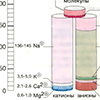
Плазма крови является водным раствором электролитов, питательных веществ, метаболитов, белков, витаминов, следовых элементов и сигнальных веществ.

Определение электролитного состава плазмы крови проводится ...

В. Состав плазмы крови

Histone H1 glycation and rutin metabolites as glycation inhibitors: Nuclear protein glycation in vivo and novel natural product AGE inhibitors / Protein glycation, induced by hyperglycemia, is implicated in the appearance of diabetic complications and the aging process. Glycation involves the non-enzymatic reaction between sugars and protein amino groups that lead to formation of advanced glycation end products (AGEs). When aminoguanidine, aHistone H1 glycation and rutin metabolites as glycation inhibitors: Nuclear protein glycation in vivo and novel natural product AGE inhibitors
Protein glycation, induced by hyperglycemia, is implicated in the appearance of diabetic complications and the aging process. Glycation involves the ...
Handbook of Nanoindentation: With Biological Applications / Broadly divided into two parts, this guide’s first part presents the a’basic sciencea’ of nanoindentation, including the background of contact mechanics underlying indentation technique, and the instrumentation used to gather mechanical data. Both the mechanics background and the instrumentation oveHandbook of Nanoindentation: With Biological Applications
Broadly divided into two parts, this guide’s first part presents the a’basic sciencea’ of nanoindentation, including the background of contact ...
Основы клинической биохимии / Авторы монографии поставили перед собой задачу отобрать наиболее достоверные и проверенные факты, описанные в литературе и подтверждённые несколькими исследователями. Кроме того, в монографии отражён их личный опыт и собственные исследования, относящиеся к клинической биохимии, выполненные в различнОсновы клинической биохимии
Авторы монографии поставили перед собой задачу отобрать наиболее достоверные и ...
Asphaltenes: Chemical Transformation during Hydroprocessing of Heavy Oils (Chemical Industries) / During the upgrading of heavy petroleum, asphaltene is the most problematic impurity since it is the main cause of catalyst deactivation and sediments formation. Exploring many aspects related to asphaltenes composition and conversion, Asphaltenes: Chemical Transformation during Hydroprocessing of HAsphaltenes: Chemical Transformation during Hydroprocessing of Heavy Oils (Chemical Industries)
During the upgrading of heavy petroleum, asphaltene is the most problematic impurity since it is the main cause of catalyst deactivation and sediments ...