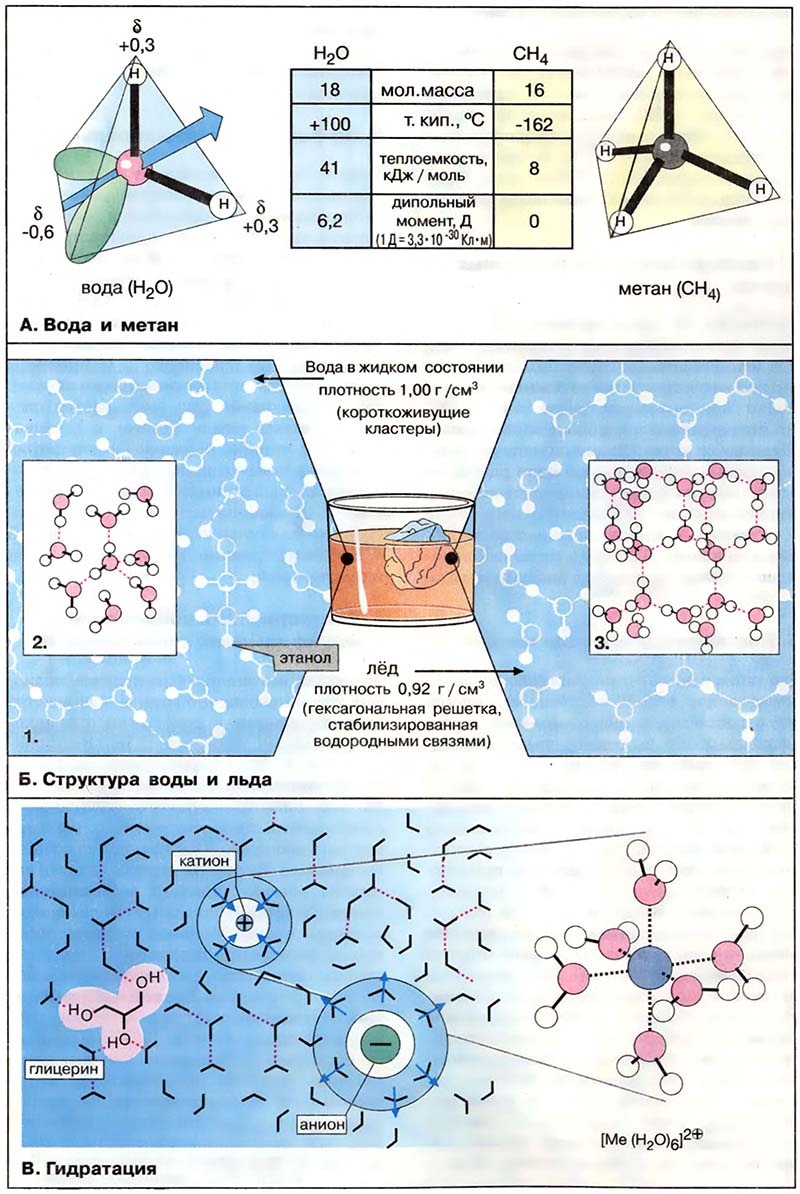
Биполярное строение молекул воды благоприятствует образованию водородных связей (см. Строение молекул). При этом каждая молекула проявляет свойства как донора, так и акцептора водорода. Поэтому у воды в жидком состоянии многие молекулы связаны между собой водородными «мостиками» (связями) (1), причём образующиеся ассоциаты находятся в динамическом равновесии. Часто образуются тетраэдрические структуры, так называемые «кластеры» воды (2). При понижении температуры доля кластеров возрастает вплоть до начала кристаллизации. При нормальном атмосферном давлении вода кристаллизуется при 0 °С, при этом большинство молекул воды оказываются встроенными в гексагональную решётку (3).
Поскольку в твёрдом состоянии расстояние между молекулами в среднем больше, чем в жидкости, плотность льда меньше по сравнению с плотностью воды. Это свойство воды очень важно в экологическом отношении хотя бы потому, что зимой на поверхности водоёмов образуется слой льда и они редко промерзают до дна.
Поскольку в твёрдом состоянии расстояние между молекулами в среднем больше, чем в жидкости, плотность льда меньше по сравнению с плотностью воды. Это свойство воды очень важно в экологическом отношении хотя бы потому, что зимой на поверхности водоёмов образуется слой льда и они редко промерзают до дна.
Статьи раздела «Вода как растворитель»:
- Вода как растворитель
- А. Вода и метан
- Б. Структура воды и льда
- В. Гидратация
Структура:
Списки:
Сложность материала:
Величины и единицы:
Книги Список книг
 Gene Control
 Gene Control offers an articulate, current description of how gene expression is controlled in eukaryotes, reviewing and summarizing the extensive ...
 Методы в молекулярной биофизике. Структура. Функция. Динамика. В 2 томах. Том 2
 Учебное пособие посвящено современному описанию физико-химических подходов, ...
 Солитоны в молекулярных системах
 В монографии изложены новейшие подходы к изучению транспорта энергии и ...
 Металлы, которые всегда с тобой
 Металлы, находящиеся в незначительных количествах внутри живого организма, ...