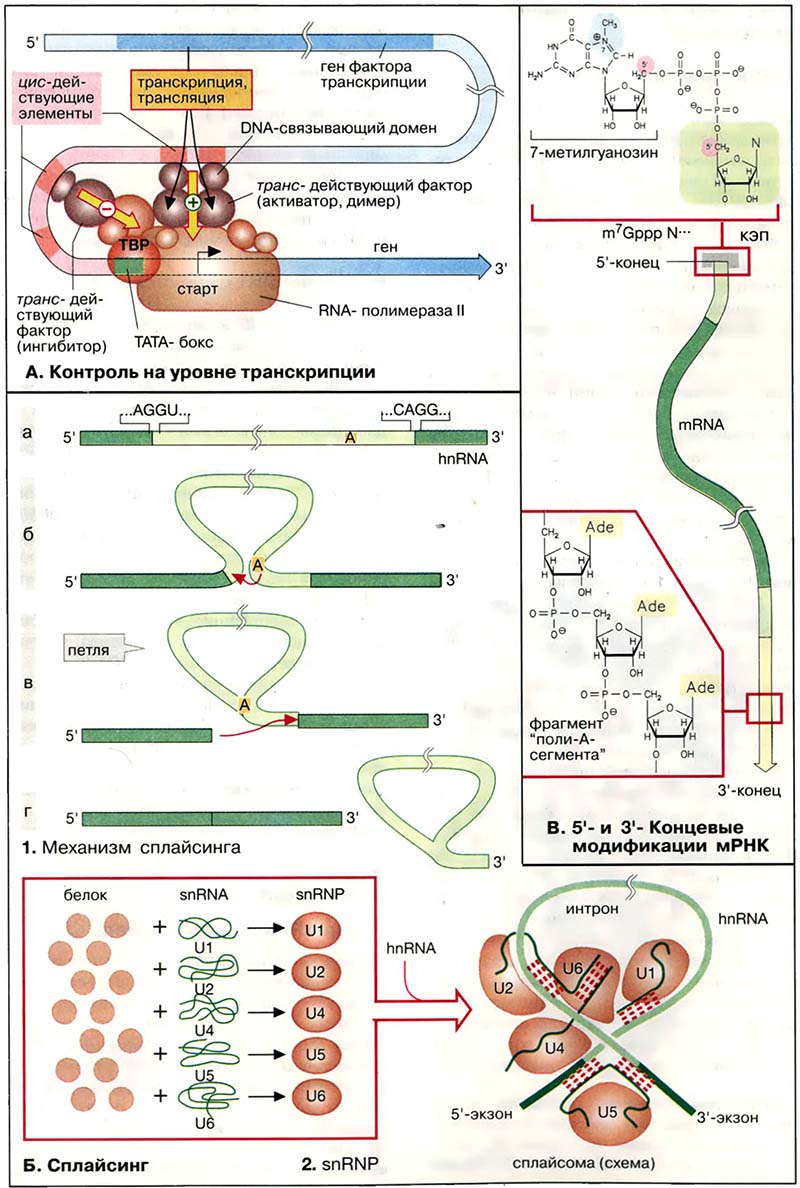
Порядок транскрибирования генов определяется регуляторной системой, которая носит название системы регуляции транскрипции. Контроль транскрипции осуществляется структурами двух типов. Большинство генов содержат в своём промоторном участке (см. Транскрипция) несколько коротких сегментов ДНК (DNA) (регуляторные элементы, цис-действующие элементы), с которыми могут связываться факторы транскрипции. Регуляторные элементы, стимулирующие транскрипцию связанных с ними генов, называются энхансерами (усилителями, от англ. enhancer). Белки, подавляющие транскрипцию, — сайленсерами (успокоителями, от англ. silencer). Факторы транскрипции — это белки, то есть продукты других, независимых генов. Поэтому их называют опосредованно действующими факторами.
Для процесса транскрипции генов требуются не только РНК-полимераза, но и другие белки, называемые основными факторами транскрипции. Установлено, что у эукариот таким фактором является ТАТА-связывающий белок (ТСБ, англ. ТАТА-Вох Binding Protein, ТВР), который взаимодействует с основным регуляторным элементом, ТАТА-боксом, присутствующим в большинстве генов. С этим комплексом затем связываются другие основные факторы транскрипции и РНК-полимеразы. Дополнительные факторы могут влиять на инициацию транскрипции, связываясь с другими регуляторными элементами. Отсюда они взаимодействуют с основным транскрипционным комплексом, либо активируя, либо ингибируя его. Такие факторы активируют, например, комплексы стероидных гормонов с рецепторами (см. Механизм действия липофильных гормонов). По завершении транскрипции из гяРНК вырезаются интроны, содержащие некодирующие последовательности.
Для процесса транскрипции генов требуются не только РНК-полимераза, но и другие белки, называемые основными факторами транскрипции. Установлено, что у эукариот таким фактором является ТАТА-связывающий белок (ТСБ, англ. ТАТА-Вох Binding Protein, ТВР), который взаимодействует с основным регуляторным элементом, ТАТА-боксом, присутствующим в большинстве генов. С этим комплексом затем связываются другие основные факторы транскрипции и РНК-полимеразы. Дополнительные факторы могут влиять на инициацию транскрипции, связываясь с другими регуляторными элементами. Отсюда они взаимодействуют с основным транскрипционным комплексом, либо активируя, либо ингибируя его. Такие факторы активируют, например, комплексы стероидных гормонов с рецепторами (см. Механизм действия липофильных гормонов). По завершении транскрипции из гяРНК вырезаются интроны, содержащие некодирующие последовательности.
Статьи раздела «Созревание РНК»:
- Созревание РНК
- А. Контроль на уровне транскрипции
- Б. Сплайсинг
- В. 5′- и 3′-Концевые модификации мРНК
Структура:
Списки:
Сложность материала:
Величины и единицы:
Книги Список книг
 Microbiology with Diseases by Taxonomy with MasteringMicrobiology (3rd Edition)
 The Third Edition of Microbiology with Diseases by Taxonomy is the most cutting-edge microbiology book available, offering unparalleled currency, ...
 Введение в молекулярную биологию
 Книга представляет собой переработанный курс лекций, который авторы читают ...
 Microarray Image Analysis: An Algorithmic Approach (Chapman & Hall/CRC Computer Science & Data Analysis)
 To harness the high-throughput potential of DNA microarray technology, it is crucial that the analysis stages of the process are decoupled from the ...
 Фотосинтез: физико-химический подход
 Подробно обосновывается предложенная автором (1995) принципиально новая концепция ...