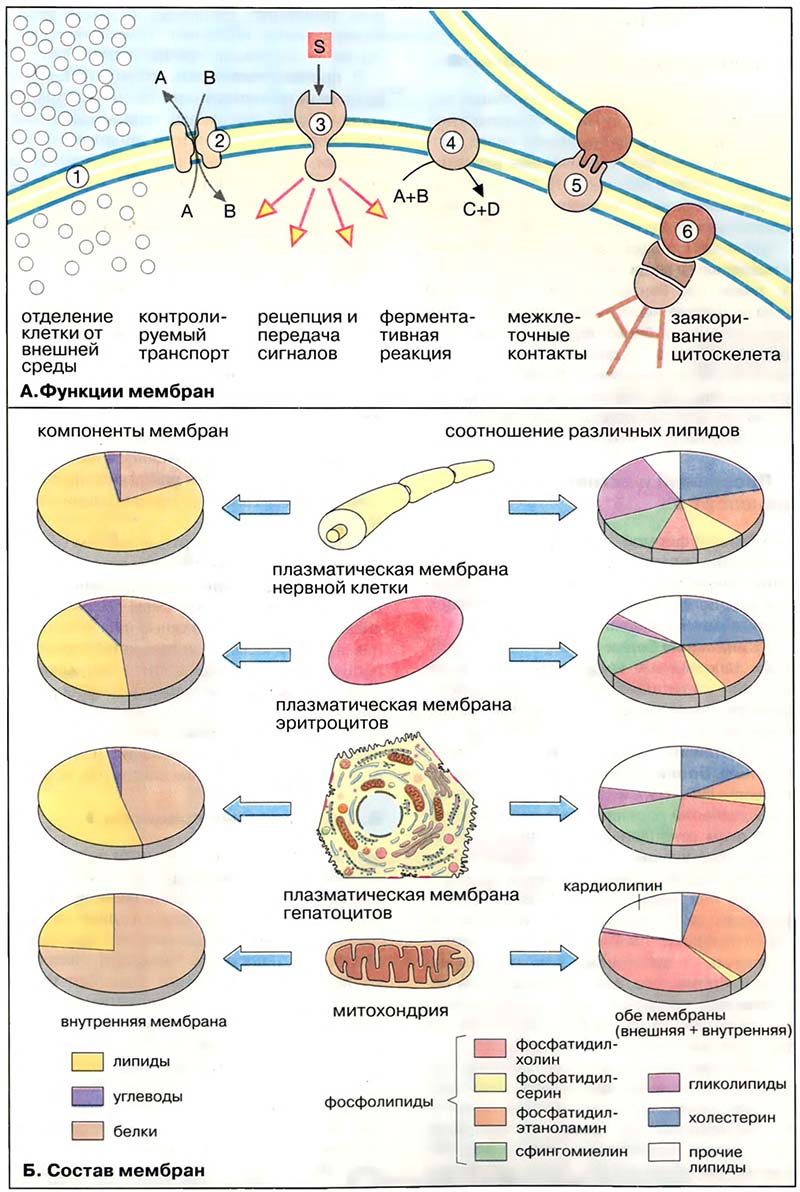
Биомембраны состоят из липидов, белков и углеводов (см. Функции и состав биомембран). Соотношение этих компонентов варьирует от одной мембраны к другой (слева на схеме). Главными компонентами обычно являются белки, составляющие около половины от массы мембраны. Углеводы найдены только во внешнем слое; они составляют всего несколько процентов от массы мембраны. Примером необычного состава служит миелин оболочки нервных клеток, который на три четверти представлен липидами. Напротив, для внутренней мембраны митохондрий характерны низкое содержание липидов и высокий уровень белков.
Более детальный анализ состава липидов в различных мембранах выявляет их клеточную и тканевую специфичность. На схеме справа показано разнообразие мембранных липидов и их относительное содержание в различных мембранах. Видно, что в количественном отношении преобладают фосфолипиды, затем следуют гликолипиды и холестерин. Триацилглицерины (нейтральные жиры) в мембранах не обнаружены. Холестерин найден почти исключительно в эукариотических клетках. Мембраны животных клеток содержат холестерина гораздо больше, чем мембраны растений, в которых холестерин обычно заменён другими стеринами. У прокариот за несколькими исключениями вообще нет холестерина. Внутренняя митохондриальная мембрана эукариот также почти полностью лишена холестерина.
Более детальный анализ состава липидов в различных мембранах выявляет их клеточную и тканевую специфичность. На схеме справа показано разнообразие мембранных липидов и их относительное содержание в различных мембранах. Видно, что в количественном отношении преобладают фосфолипиды, затем следуют гликолипиды и холестерин. Триацилглицерины (нейтральные жиры) в мембранах не обнаружены. Холестерин найден почти исключительно в эукариотических клетках. Мембраны животных клеток содержат холестерина гораздо больше, чем мембраны растений, в которых холестерин обычно заменён другими стеринами. У прокариот за несколькими исключениями вообще нет холестерина. Внутренняя митохондриальная мембрана эукариот также почти полностью лишена холестерина.
Статьи раздела «Функции и состав биомембран»:
- Функции и состав биомембран
- А. Функции биомембран
- Б. Состав биомембран
Структура:
Списки:
Сложность материала:
Величины и единицы:
Книги Список книг
 Biomolecular Crystallography: Principles, Practice, and Application to Structural Biology
 Synthesizing over thirty years of advances into a comprehensive textbook, Biomolecular Crystallography describes the fundamentals, practices, and ...
 Нелинейная динамика взаимодействующих популяций
 Проведён анализ режимов динамического поведения в системах нескольких ...
 Principles of Biomedical Informatics
 Biomedical informatics (BMI) is an extraordinarily broad discipline. In scale, it spans across genes, cells, tissues, organ systems, individual ...
