Коферменты переноса групп

В данном разделе рассматриваются коферменты, участвующие в реакции переноса групп. Кобамид (кофермент B12) будет рассмотрен в статье Водорастворимые витамины. II.
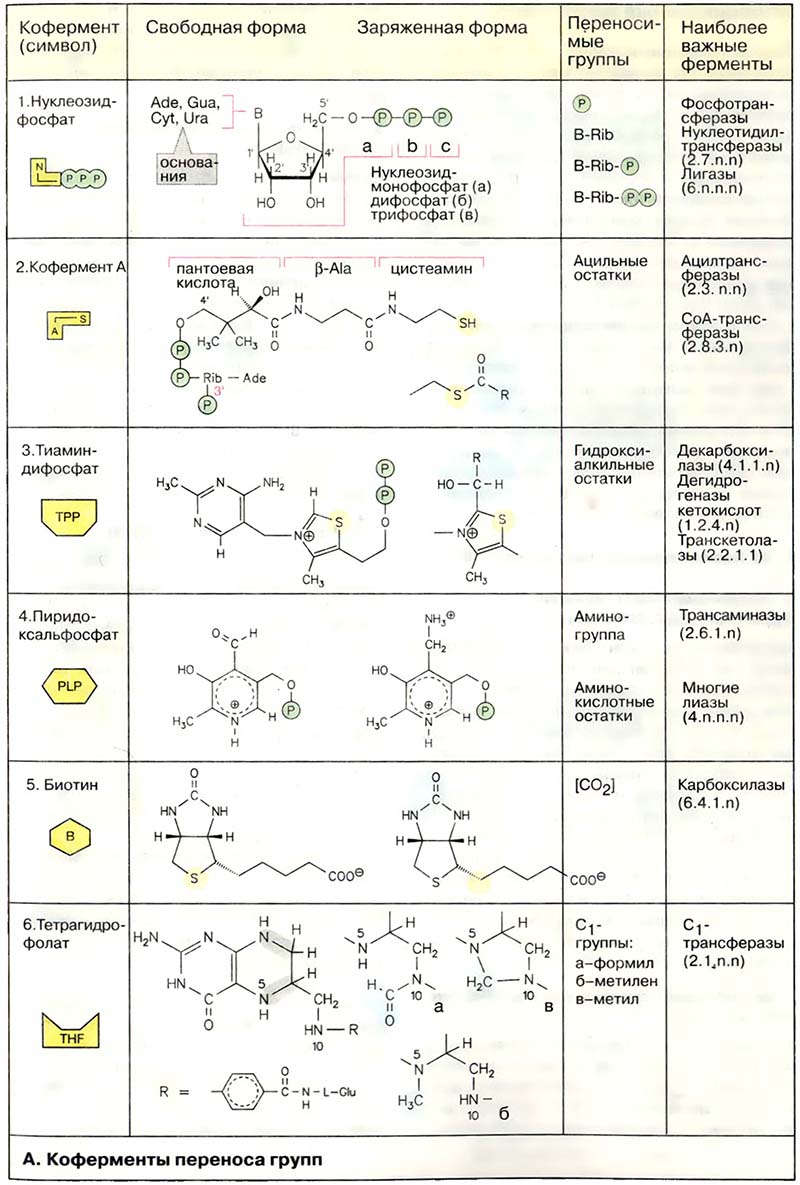

Метаболизм. Ферменты / Коферменты переноса групп

Статьи раздела «Коферменты переноса групп»:

Следущая статья   |   — Вернуться в раздел


Review of Medical Microbiology and Immunology / To put your preparation for USMLE Step 1 and course exams on the fast track, only one resource will do: «Review of Medical Microbiology and Immunology». Completely updated throughout, the Eleventh Edition presents a high-yield review of the basic and clinical aspects of bacteriology, virology, mycolReview of Medical Microbiology and Immunology
To put your preparation for USMLE Step 1 and course exams on the fast track, only one resource will do: «Review of Medical Microbiology and ...
Cell Biology: With STUDENT CONSULT Online Access / A masterful, richly illustrated introduction to the cell biology that you need to know.Cell Biology: With STUDENT CONSULT Online Access
A masterful, richly illustrated introduction to the cell biology that you need to know.
Role of TCF in body axis formation: Discovery of a Dual Action of XTCF-3 in Xenopus Body Axis Formation / A novel role of TCF family in body axis formation. Revolutionary high impact discoveries are described, elucidating the missing link in the Wnt pathway and protein-TCF combinations with dual functions. By studying the primary axis formation of Xenopus laevis, it was firstly shown that, in combinatioRole of TCF in body axis formation: Discovery of a Dual Action of XTCF-3 in Xenopus Body Axis Formation
A novel role of TCF family in body axis formation. Revolutionary high impact discoveries are described, elucidating the missing link in the Wnt ...
Histone H1 glycation and rutin metabolites as glycation inhibitors: Nuclear protein glycation in vivo and novel natural product AGE inhibitors / Protein glycation, induced by hyperglycemia, is implicated in the appearance of diabetic complications and the aging process. Glycation involves the non-enzymatic reaction between sugars and protein amino groups that lead to formation of advanced glycation end products (AGEs). When aminoguanidine, aHistone H1 glycation and rutin metabolites as glycation inhibitors: Nuclear protein glycation in vivo and novel natural product AGE inhibitors
Protein glycation, induced by hyperglycemia, is implicated in the appearance of diabetic complications and the aging process. Glycation involves the ...