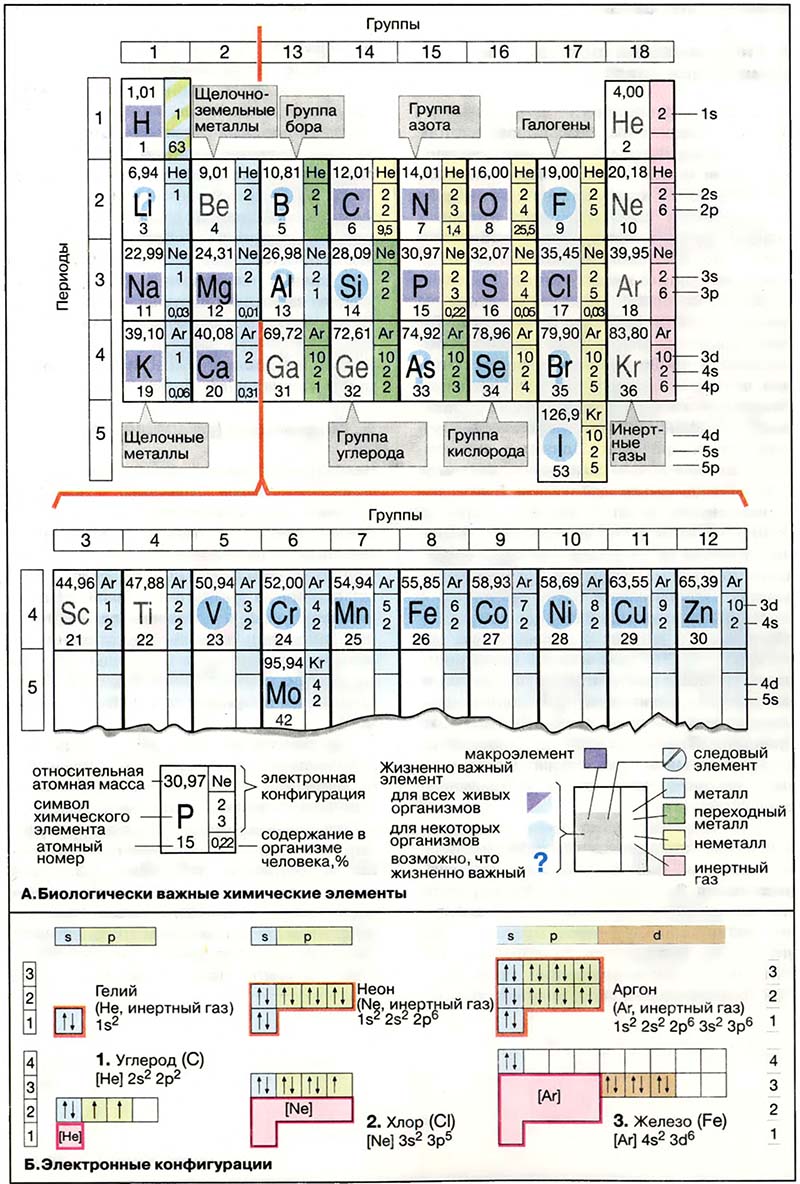
В природе встречается 81 стабильный химический элемент. В состав живой материи входят 15 элементов, ещё 8-10 элементов обнаружены только в определённых организмах. На схеме приведена часть Периодической системы элементов, в которой содержатся все биологически важные химические элементы, даны их физические и химические характеристики, а также содержание в живой материи и организме человека. Закономерности строения атомов, лежащие в основе периодической системы, детально рассматриваются в учебниках по химии.
Живые организмы почти на 99% состоят из четырёх химических элементов: водорода (Н), кислорода (O), углерода (C) и азота (N). Водород и кислород — составные элементы воды, на которую приходится 60-70% массы клетки (см. Структура клеток). Наряду с углеродом и азотом эти два элемента являются также основными составляющими органических соединений, участвующих в большинстве процессов жизнедеятельности. Многие биомолекулы содержат также атомы серы (S) и фосфора (P). Перечисленные макроэлементы входят в состав всех живых организмов.
Химические элементы, относящиеся ко второй важной в биологическом отношении группе и в сумме составляющие примерно 0,5% массы человека, присутствуют, за немногими исключениями, в виде ионов. Эта группа включает щелочные металлы натрий (Na) и калий (K), щёлочноземельные металлы магний (Mg) и кальций (Ca). Галоген хлор (Cl) также всегда присутствует в клетках в форме аниона. Другие жизненно важные (эссенциальные) химические элементы присутствуют в столь малых количествах, что их называют следовыми элементами. Эта группа включает переходные металлы железо (Fe), цинк (Zn), медь (Cu), кобальт (Co) и марганец (Mn). К жизненно важным микроэлементам относятся также некоторые неметаллы, такие, как йод (I) и селен (Se).
Живые организмы почти на 99% состоят из четырёх химических элементов: водорода (Н), кислорода (O), углерода (C) и азота (N). Водород и кислород — составные элементы воды, на которую приходится 60-70% массы клетки (см. Структура клеток). Наряду с углеродом и азотом эти два элемента являются также основными составляющими органических соединений, участвующих в большинстве процессов жизнедеятельности. Многие биомолекулы содержат также атомы серы (S) и фосфора (P). Перечисленные макроэлементы входят в состав всех живых организмов.
Химические элементы, относящиеся ко второй важной в биологическом отношении группе и в сумме составляющие примерно 0,5% массы человека, присутствуют, за немногими исключениями, в виде ионов. Эта группа включает щелочные металлы натрий (Na) и калий (K), щёлочноземельные металлы магний (Mg) и кальций (Ca). Галоген хлор (Cl) также всегда присутствует в клетках в форме аниона. Другие жизненно важные (эссенциальные) химические элементы присутствуют в столь малых количествах, что их называют следовыми элементами. Эта группа включает переходные металлы железо (Fe), цинк (Zn), медь (Cu), кобальт (Co) и марганец (Mn). К жизненно важным микроэлементам относятся также некоторые неметаллы, такие, как йод (I) и селен (Se).
Статьи раздела «Периодическая система элементов Д. И. Менделеева»:
- А. Биологически важные химические элементы
- Б. Электронные конфигурации
Структура:
Списки:
Сложность материала:
Величины и единицы:
Книги Список книг
 Molecular Biology of the Cell: The Problems Book
 The Problems Book helps students appreciate the ways in which experiments and simple calculations can lead to an understanding of how cells work by ...

 Биоматериалы, искусственные органы и инжиниринг тканей
 Данная книга рассказывает о разработках, проводимых на стыке многих научных ...
