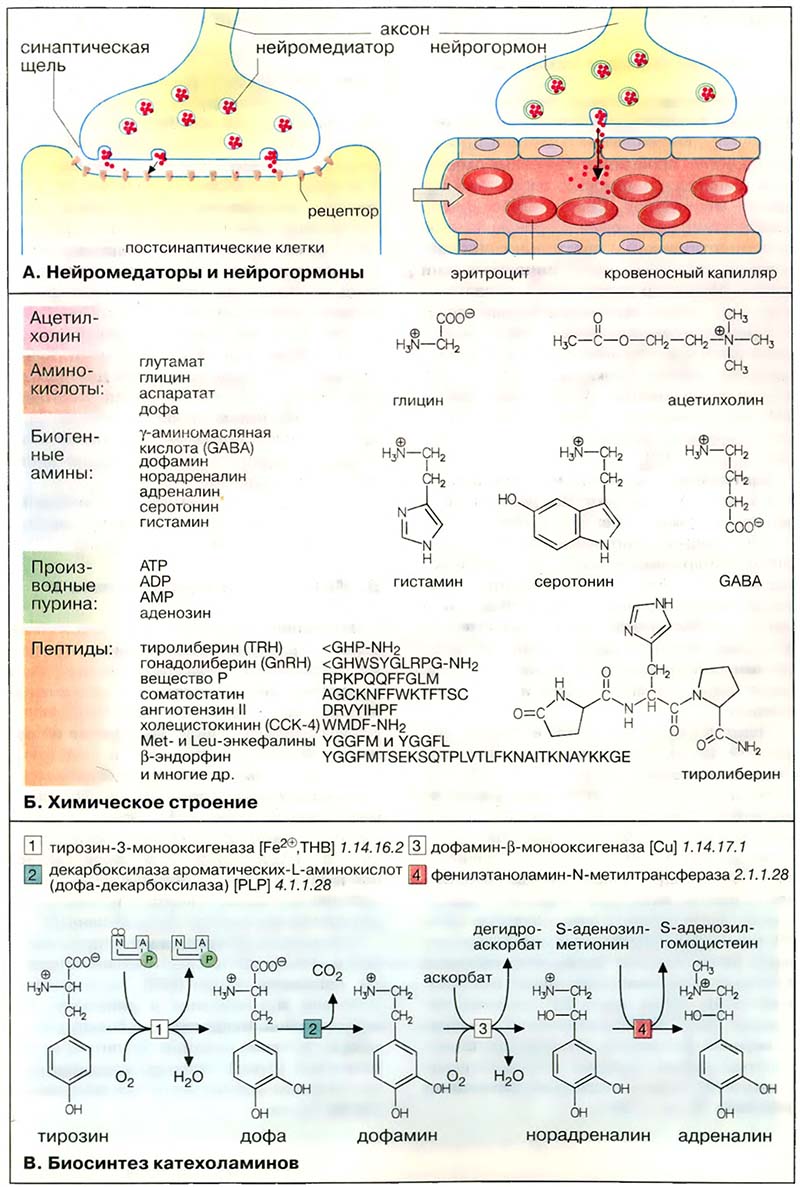
Катехоламины — группа биогенных аминов, содержащих в качестве общего фрагмента 3,4-дигидроксифенилаланин («катехол»). Биосинтез этих веществ начинается с аминокислоты тирозина. Гидроксилирование тирозина [1] приводит к образованию 3,4-дигидроксифенилаланина (дофа). При последующем декарбоксировании [2] образуется дофамин. При дальнейшем гидроксилировании [3] дофамин превращается в норадреналин (норэпинефрин). Донором водорода в этой реакции служит аскорбат (см. Водорастворимые витамины. II). Наконец, метилирование норадреналина [4] приводит к образованию адреналина (эпинефрина). Дофамин, норадреналин и адреналин являются медиаторами. Адреналин выполняет функции как медиатора, так и гормона.
Статьи раздела «Медиаторы нервной системы»:
- А. Нейромедаторы и нейрогормоны
- Б. Химическое строение
- В. Биосинтез катехоламинов
Структура:
Списки:
Сложность материала:
Величины и единицы:
Книги Список книг
 Molecular Biology of the Cell: The Problems Book
 The Problems Book helps students appreciate the ways in which experiments and simple calculations can lead to an understanding of how cells work by ...
 Фотосинтез. В 2 томах (комплект)
 Книга, написанная в основном американскими авторами, представляет собой ...
 Isotope Effects: in the Chemical, Geological, and Bio Sciences
 As the title suggests, Isotope Effects in the Chemical, Geological and Bio Sciences deals with differences in the properties of isotopically ...
 Молекула, жизнь, организм
 Учащиеся, прочитав эту книгу, смогут составить представление о том, что же такое ...