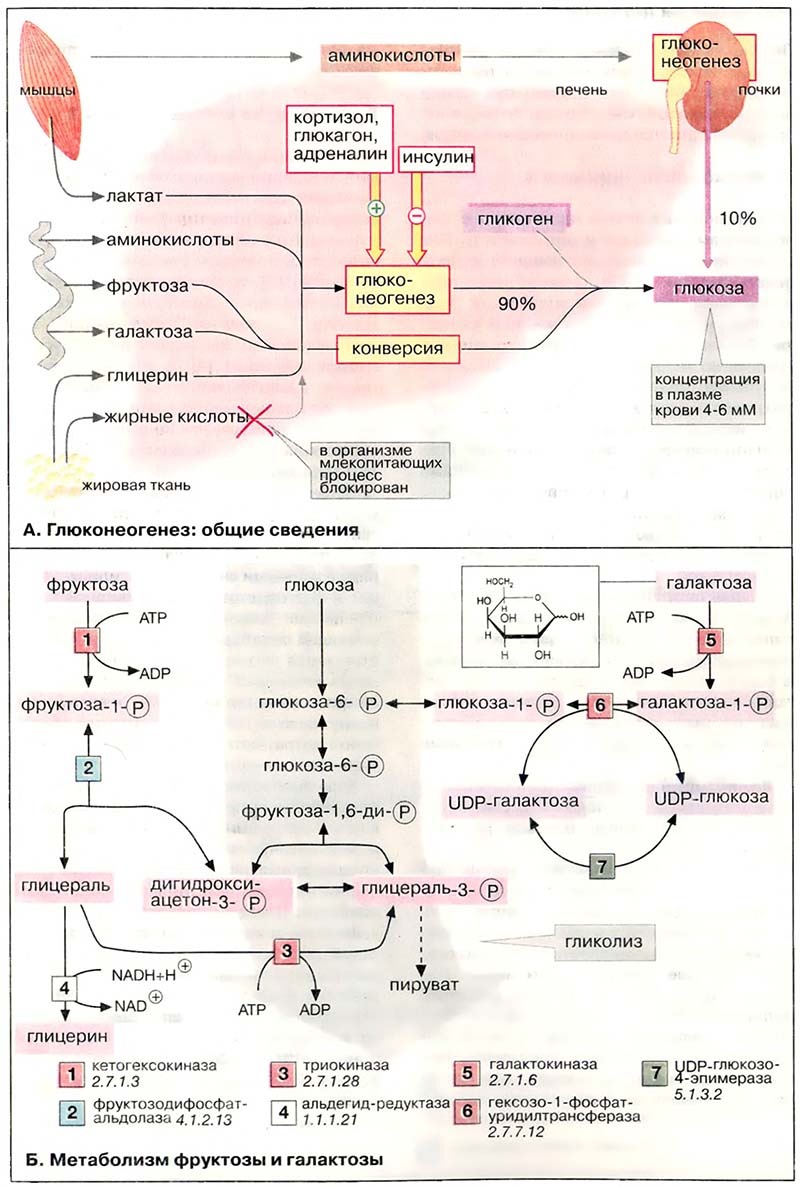
Метаболизм фруктозы осуществляется превращением её в глюкозу (на схеме слева). Вначале фруктоза фосфорилируется при участии фермента кетогексокиназы (фруктокиназы) [1] с образованием фруктозо-1-фосфата, который далее расщепляется альдолазой до глицеральдегида (глицераля) и дигидроксиацетон-3-фосфата [2]. Последний уже является промежуточным продуктом гликолиза (в центре схемы), а глицераль фосфорилируется в присутствии триокиназы, образуя глицераль-3-фосфат [3].
Затем глицеральдегид частично восстанавливается до глицерина [4] или окисляется до глицерата. После фосфорилирования оба соединения вновь включаются в гликолиз (на схеме не приведено). При восстановлении глицеральдегида [4] расходуется НАДН (NADH). Поскольку при конверсии этанола лимитирующим фактором является низкое соотношение концентраций HAD+/НАДН (NAD+/NADH), этот процесс ускоряется в присутствии фруктозы (см. Метаболизм этанола).
Кроме того, в печени реализуется полиольный путь трансформации фруктозы в глюкозу (на схеме не приведён): фруктоза за счёт восстановления C-2 превращается в сорбит, а при последующем дегидрировании C-1 — в глюкозу.
Метаболизм галактозы также начинается с фосфорилирования с образованием галактозо-1 -фосфата [5] (на схеме справа). Далее следует эпимеризация C-4 с образованием производного глюкозы. Биосинтез УДФ-глюкозы (UDP-глюкозы), промежуточного продукта обмена глюкозы, осуществляется обходным путём — через УДФ-галактозу (UDP-галактозу) и последующую эпимеризацию [6, 7]. По такому же пути идёт биосинтез самой галактозы, поскольку все реакции за исключением [5] обратимы.
Затем глицеральдегид частично восстанавливается до глицерина [4] или окисляется до глицерата. После фосфорилирования оба соединения вновь включаются в гликолиз (на схеме не приведено). При восстановлении глицеральдегида [4] расходуется НАДН (NADH). Поскольку при конверсии этанола лимитирующим фактором является низкое соотношение концентраций HAD+/НАДН (NAD+/NADH), этот процесс ускоряется в присутствии фруктозы (см. Метаболизм этанола).
Кроме того, в печени реализуется полиольный путь трансформации фруктозы в глюкозу (на схеме не приведён): фруктоза за счёт восстановления C-2 превращается в сорбит, а при последующем дегидрировании C-1 — в глюкозу.
Метаболизм галактозы также начинается с фосфорилирования с образованием галактозо-1 -фосфата [5] (на схеме справа). Далее следует эпимеризация C-4 с образованием производного глюкозы. Биосинтез УДФ-глюкозы (UDP-глюкозы), промежуточного продукта обмена глюкозы, осуществляется обходным путём — через УДФ-галактозу (UDP-галактозу) и последующую эпимеризацию [6, 7]. По такому же пути идёт биосинтез самой галактозы, поскольку все реакции за исключением [5] обратимы.
Статьи раздела «Метаболизм углеводов»:
- Метаболизм углеводов
- А. Глюконеогенез: общие сведения
- Б. Метаболизм фруктозы и галактозы
Структура:
Списки:
Сложность материала:
Величины и единицы:
Книги Список книг
 Металлы, которые всегда с тобой
 Металлы, находящиеся в незначительных количествах внутри живого организма, ...
 Молекула, жизнь, организм
 Учащиеся, прочитав эту книгу, смогут составить представление о том, что же такое ...
 Молекулярная биология. Проблемы и перспективы
 В книге собраны лучшие из современных методов выделения и анализа важнейшего ...
