Эйкозаноиды

Медиаторы (локальные гормоны) — широко распространённая группа сигнальных веществ, которые образуются почти во всех клетках организма и имеют небольшую дальность действия. Этим они отличаются от классических гормонов, синтезирующихся в специальных клетках желез внутренней секреции. Наиболее важными представителями медиаторов являются гистамин и эйкозаноиды. В этом разделе на примере эйкозаноидов рассматриваются основные свойства медиаторов.
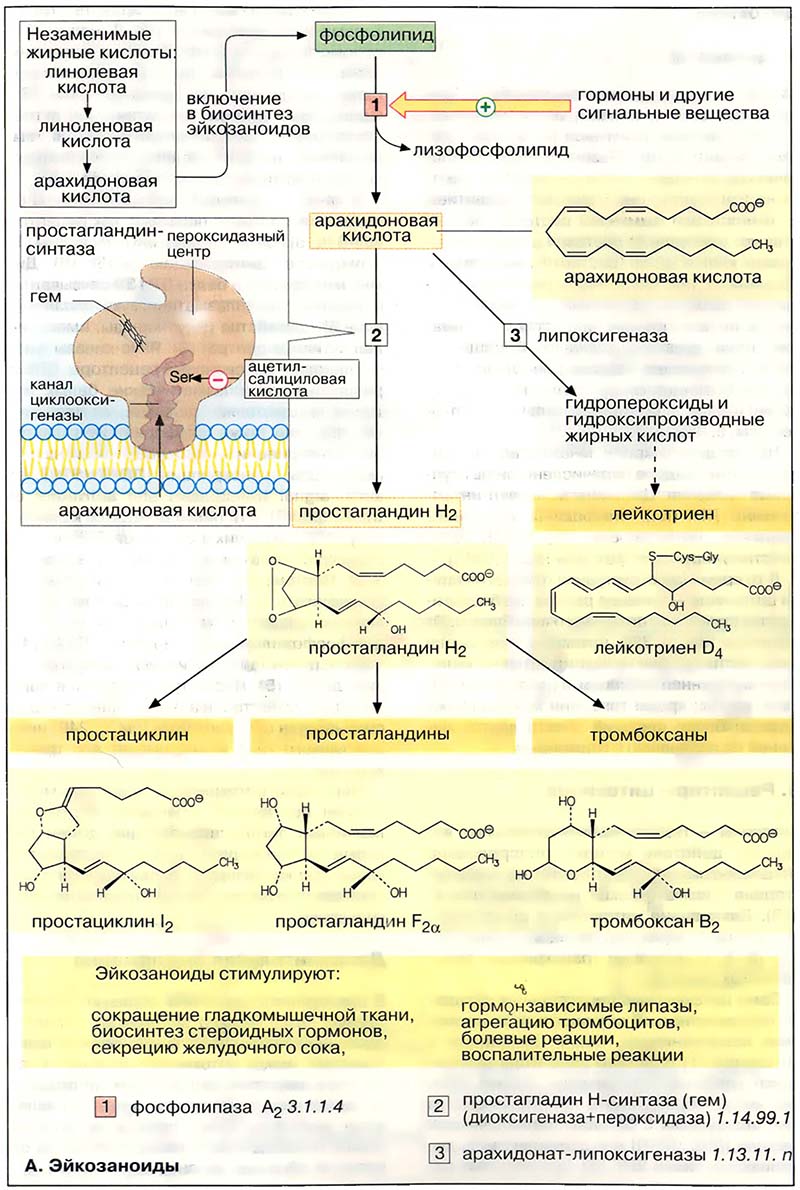

Гормоны. Медиаторы / Эйкозаноиды

Статьи раздела «Эйкозаноиды»:

— Следущая статья   |   — Вернуться в раздел


The Reef Aquarium: Science, Art, and Technology, Vol. 3 / The Reef Aquarium Volume Three: Science, Art, and Technology Reefkeeping science involves the interplay of biology, chemistry, and physics. However, a reef aquarium is not simply a product of scientific knowledge. The application of engineering and its product technology, makes it possible to duplicThe Reef Aquarium: Science, Art, and Technology, Vol. 3
The Reef Aquarium Volume Three: Science, Art, and Technology Reefkeeping science involves the interplay of biology, chemistry, and physics. However, a ...
Биогенный магнетит и магниторецепция (комплект из 2 книг) / Монографический сборник американских авторов первый в мировой литературе обобщающий труд по магнитобиологии. В т. 1 собрана исчерпывающая информация о наблюдаемых биологических эффектах магнитного поля, сформулированы концепции относительно их физических основ. В т. 2 подробно описаны новые методы иБиогенный магнетит и магниторецепция (комплект из 2 книг)
Монографический сборник американских авторов первый в мировой литературе ...
Molecular Biology of the Cell: The Problems Book / The Problems Book helps students appreciate the ways in which experiments and simple calculations can lead to an understanding of how cells work by introducing the experimental foundation of cell and molecular biology. Each chapter will review key terms, test for understanding basic concepts, and poMolecular Biology of the Cell: The Problems Book
The Problems Book helps students appreciate the ways in which experiments and simple calculations can lead to an understanding of how cells work by ...
NMR Studies of Structural Motifs: Protein Folding and Ligand Binding / NMR of Structural Motifs: The agrin G3 domain is critical in development and maintenance of the neuromuscular junction. G3 binds -dystroglycan and initiates acetylcholine receptor clustering on myotube membranes. Using NMR spectroscopy, we show both active B8 and inactive B0 isoforms binding sialic NMR Studies of Structural Motifs: Protein Folding and Ligand Binding
NMR of Structural Motifs: The agrin G3 domain is critical in development and maintenance of the neuromuscular junction. G3 binds -dystroglycan and ...