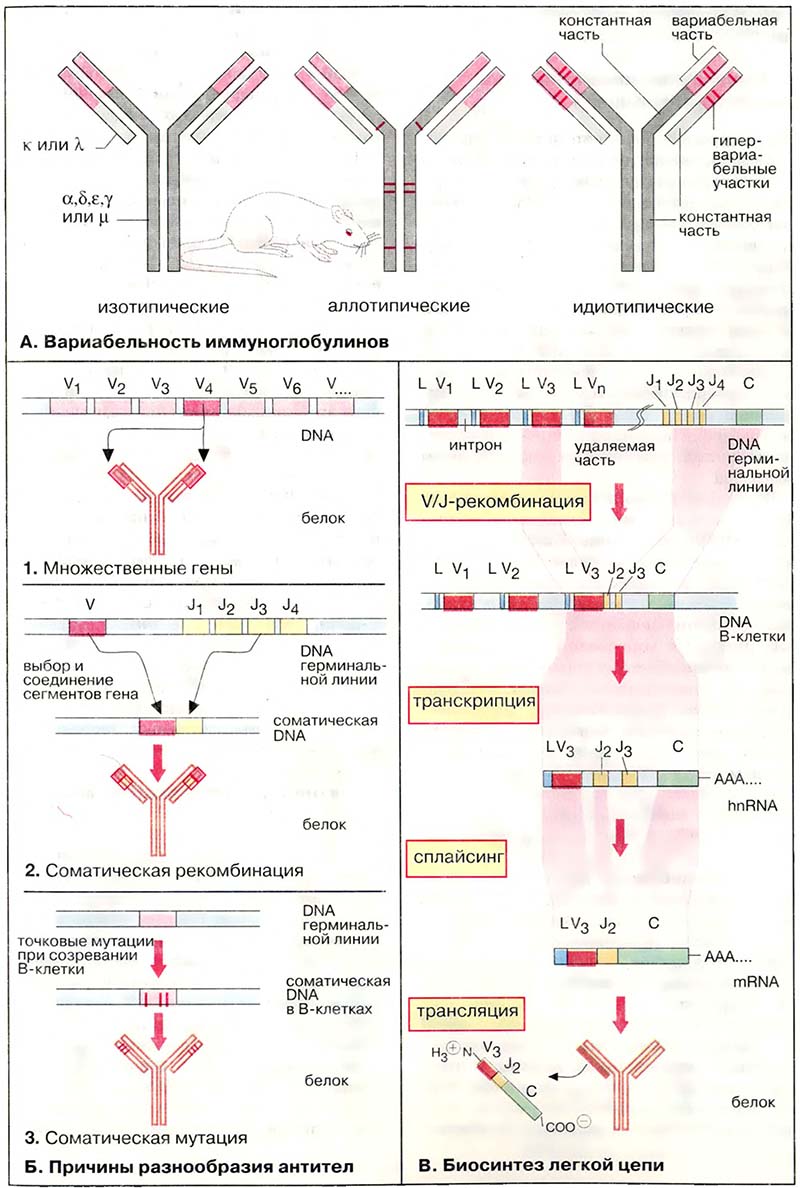
Рассмотрим основные особенности организации гена иммуноглобулина и его экспрессии на примере биосинтеза мышиной κ-цепи. Сегменты гена, кодирующие эту лёгкую цепь, обозначаются как L, V, J и C. Они локализованы на хромосоме 6 в ДНК (DNA) герминальной линии клеток мыши (у человека на хромосоме 2) и разделены друг от друга интронами различной длины.
Примерно 150 идентичных сегментов L гена кодируют сигнальный пептид (17-20 аминокислот) для секреции продукта (см. Сортировка белков). Наибольшая часть вариабельного домена (95 из 108 аминокислотных остатков) кодируется около 150 различными V-сегментами, расположенными рядом с L-сегментом. L- и V-сегменты всегда расположены парами, так называемым тандемом. Напротив, для J-сегмента (от англ. joining) существует максимально только пять вариантов. Они кодируют пептид из 13 аминокислотных остатков, который связывает вариабельную и константную части к-цепи. Константная часть лёгкой цепи (84 аминокислоты) кодируется единственным C-сегментом.
Во время дифференциации В-лимфоцитов уникальная V/J-комбинация возникает в каждой B-клетке. Один из 150 сегментов L-V-тандема выбирается и связывается с одним из пяти J-сегментов. Это приводит к возникновению соматического гена, который значительно меньше по сравнению с геном герминальной линии. Транскрипция этого гена ведёт к образованию гяРНК (hnRNA) для κ-цепи. Из этой РНК удаляются путём сплайсинга интроны и лишние J-ceгменты (см. Созревание РНК). Зрелая мРНК (mRNA) содержит сегменты L-V-J-C и после транспорта в цитоплазму готова для трансляции. Последующие шаги биосинтеза Ig те же, что и для других мембранных или секреторных белков).
Примерно 150 идентичных сегментов L гена кодируют сигнальный пептид (17-20 аминокислот) для секреции продукта (см. Сортировка белков). Наибольшая часть вариабельного домена (95 из 108 аминокислотных остатков) кодируется около 150 различными V-сегментами, расположенными рядом с L-сегментом. L- и V-сегменты всегда расположены парами, так называемым тандемом. Напротив, для J-сегмента (от англ. joining) существует максимально только пять вариантов. Они кодируют пептид из 13 аминокислотных остатков, который связывает вариабельную и константную части к-цепи. Константная часть лёгкой цепи (84 аминокислоты) кодируется единственным C-сегментом.
Во время дифференциации В-лимфоцитов уникальная V/J-комбинация возникает в каждой B-клетке. Один из 150 сегментов L-V-тандема выбирается и связывается с одним из пяти J-сегментов. Это приводит к возникновению соматического гена, который значительно меньше по сравнению с геном герминальной линии. Транскрипция этого гена ведёт к образованию гяРНК (hnRNA) для κ-цепи. Из этой РНК удаляются путём сплайсинга интроны и лишние J-ceгменты (см. Созревание РНК). Зрелая мРНК (mRNA) содержит сегменты L-V-J-C и после транспорта в цитоплазму готова для трансляции. Последующие шаги биосинтеза Ig те же, что и для других мембранных или секреторных белков).
Статьи раздела «Биосинтез антител»:
- А. Вариабельность иммуноглобулинов
- Б. Причины разнообразия антител
- В. Биосинтез лёгкой цепи
Структура:
Списки:
Сложность материала:
Величины и единицы:
Книги Список книг
 Микроэлементы в окружающей среде. Биогеохимия, биотехнология и биоремедиация
 Книга посвящена анализу роли микроэлементов (металлов и металлоидов) в ...
 Microarray Image Analysis: An Algorithmic Approach (Chapman & Hall/CRC Computer Science & Data Analysis)
 To harness the high-throughput potential of DNA microarray technology, it is crucial that the analysis stages of the process are decoupled from the ...
 Introductory Chemistry: Concepts and Critical Thinking (6th Edition)
 Introductory Chemistry: Concepts and Critical Thinking, Sixth Edition is a comprehensive learning system that offers print and media resources as well ...
 Кинетика и термодинамика биохимических процессов
 В книге систематически излагаются вопросы применения кинетики и термодинамики к ...