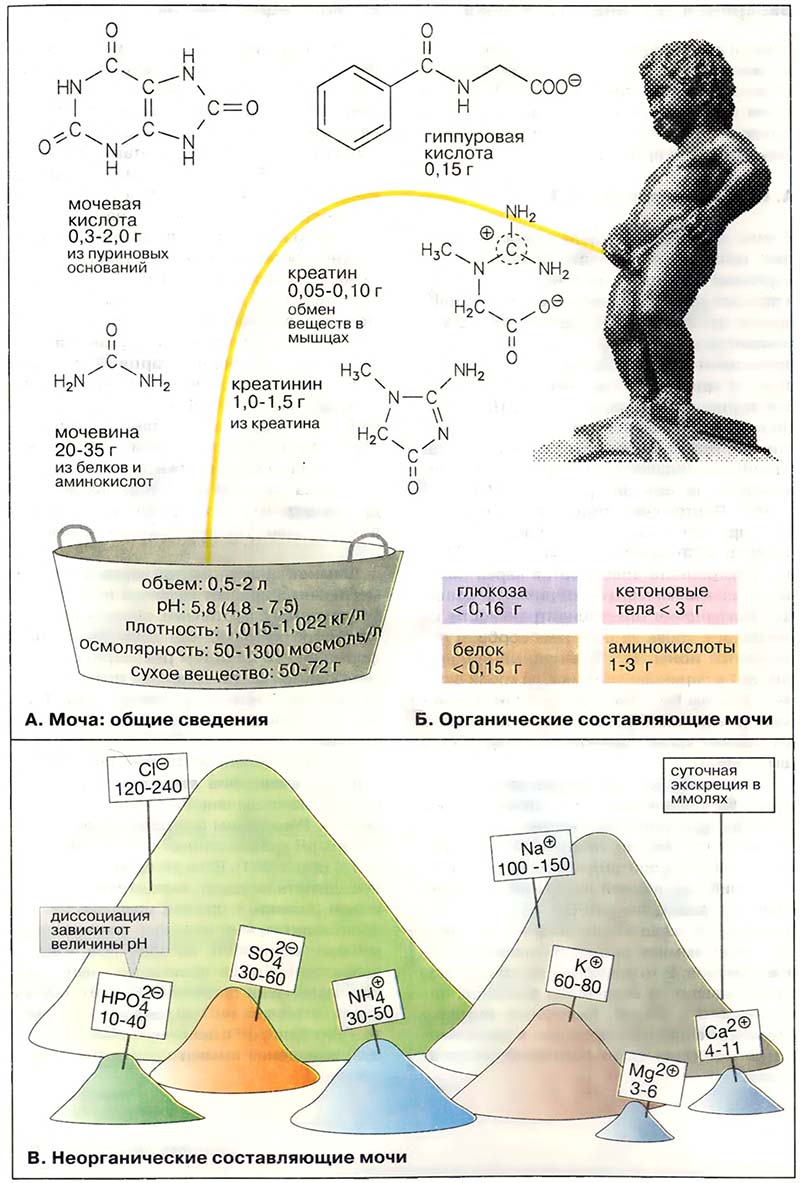
В моче присутствуют катионы Na+, K+, Ca2+, Mg2+ и NH4+, анионы Cl-, SO42- и HPO42- и в следовых количествах другие ионы. Содержание кальция и магния в фекалиях существенно выше, чем в моче. Количество неорганических веществ в значительной степени зависит от характера питания. При ацидозе может сильно повыситься экскреция аммиака (см. Экскреция протонов и аммиака). Выведение многих ионов регулируется гормонами (см. Эндокринная функция почек).
Статьи раздела «Моча»:
- А. Общие сведения
- Б. Органические составляющие мочи
- В. Неорганические составляющие мочи
- Дополнительная информация
Структура:
Списки:
Сложность материала:
Величины и единицы:
Книги Список книг
 Микрокосм. E. coli и новая наука о жизни
 Цитата «В начале XX в. учёные, стремясь познать природу жизни, начали исследовать ...
 Основы клинической биохимии
 Авторы монографии поставили перед собой задачу отобрать наиболее достоверные и ...
 Солитоны в молекулярных системах
 В монографии изложены новейшие подходы к изучению транспорта энергии и ...
 Введение в молекулярную биологию
 Задача предлагаемой книги состоит в ознакомлении читателей с важнейшими фактами ...