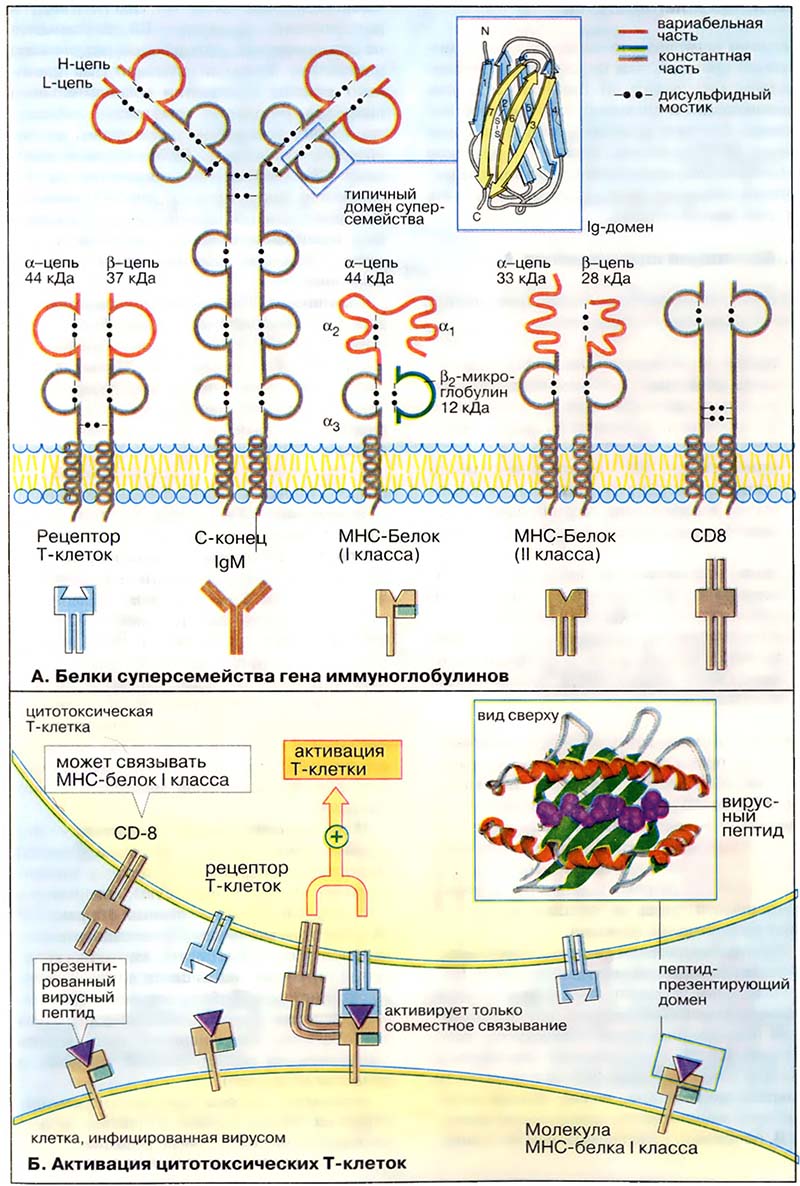
Инфицированная клетка презентирует с помощью белков ГКГС класса I небольшой чужеродный пептид, который может связываться с поверхностью Т-клетки с помощью Т-клеточных рецепторов. Цитотоксическая Т-клетка несёт на поверхности кроме Т-клеточных рецепторов также белок CD8, связывающий комплекс из молекул ГКГС и чужеродного пептида. Это активирует цитотоксическую Т-клетку и делает её способной разрушать инфицированную клетку. В рамке на рисунке показан пептидпрезентирующий домен молекулы ГКГС класса I со связанным чужеродным пептидом (на схеме фиолетового цвета).
Статьи раздела «Белки главного комплекса гисто-совместимости»:
- А. Белки суперсемейства гена иммуноглобулинов
- Б. Активация цитотоксических Т-клеток
Структура:
Списки:
Сложность материала:
Величины и единицы:
Книги Список книг
 NMR Studies of Structural Motifs: Protein Folding and Ligand Binding
NMR of Structural Motifs: The agrin G3 domain is critical in development and maintenance of the neuromuscular junction. G3 binds -dystroglycan and ...
 Metals in Medicine
Working from basic chemical principles, Metals in Medicine presents a complete and methodical approach to the topic. Introductory chapters discuss ...
 Fundamentals of Forensic DNA Typing
An introductory text on forensic DNA analysis, written by the foremost expert in the field.
 Histone H1 glycation and rutin metabolites as glycation inhibitors: Nuclear protein glycation in vivo and novel natural product AGE inhibitors
Protein glycation, induced by hyperglycemia, is implicated in the appearance of diabetic complications and the aging process. Glycation involves the ...