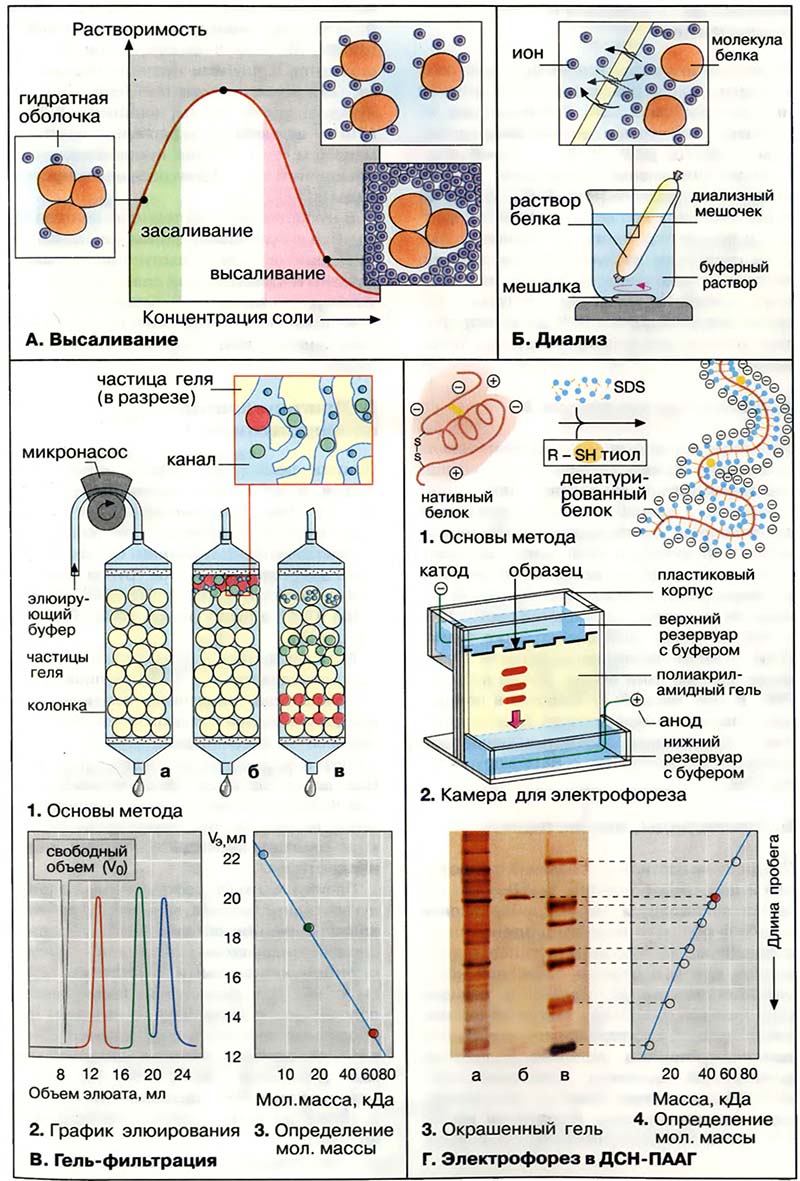
Растворимость белков сильно зависит от концентрации солей (от ионной силы). В дистиллированной воде белки чаще всего растворяются плохо, однако их растворимость возрастает по мере увеличения ионной силы. При этом все большее количество гидратированных неорганических ионов (светло-синие кружочки) связывается с поверхностью белка и тем самым уменьшается степень его агрегации (засаливание). При высокой ионной силе молекулы белков лишаются гидратирующих оболочек, что приводит к агрегации и выпадению белка в осадок (высаливание). Используя различие в растворимости, можно с помощью обычных солей, например (NH4)2SO4, разделить (фракционировать) смесь белков.
Статьи раздела «Методы выделения и анализа белков»:
Структура:
Списки:
Сложность материала:
Величины и единицы:
Книги Список книг
 Gene Control
 Gene Control offers an articulate, current description of how gene expression is controlled in eukaryotes, reviewing and summarizing the extensive ...
 Introductory Microbiology
 As a component of biology, Plant Pathology enjoyed a prestigious position and its applied aspects; plant disease management was an integral part of ...

 Молекулярные механизмы взаимодействия эндотоксинов с клетками-мишенями
 Открытие истинных рецепторов к эндотоксинам (липополисахаридам), сделанное на ...